Modus Aquae
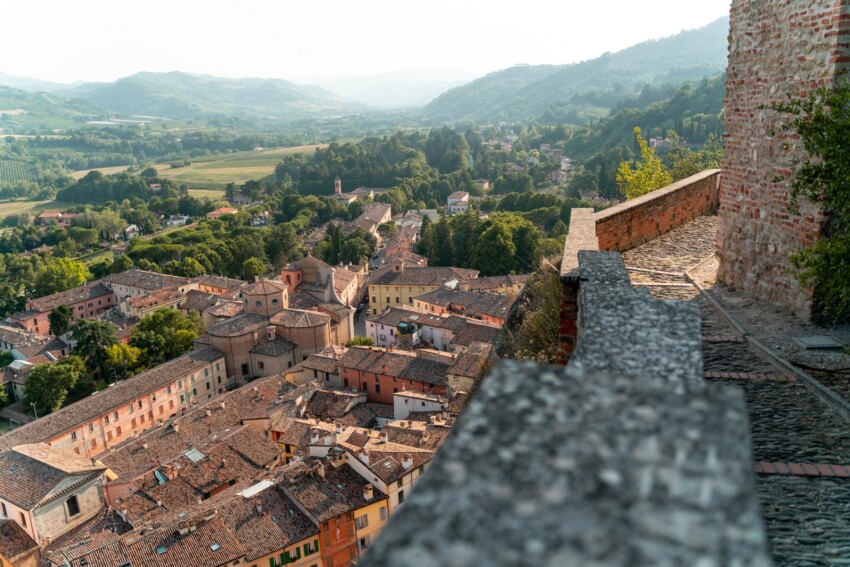
Located in north-eastern Italy, Emilia-Romagna is a region rich in history, culture and tradition, renowned for its stunning beaches, UNESCO World Heritage sites and delicious cuisine. It is a land of great historical and cultural importance that has been the birthplace of illustrious figures such as Giuseppe Verdi, Federico Fellini and Luciano Pavarotti, and is also home to world-famous gastronomic products such as Parma Ham and Parmigiano Reggiano.
Beyond important and well-known cities such as Bologna, Parma and Ravenna, Emilia-Romagna boasts a collection of villages that not only preserve a unique and enchanting atmosphere but also a long history and age-old customs. The villages of Emilia-Romagna are often genuine hidden gems that allow you to journey back in time discovering traditions and sites that hold unique testimonies. Moreover, many of these charming towns are surrounded by picturesque landscapes, vineyards, olive groves and rolling hills that offer breathtaking views of the surrounding territories.
Here then is a mini-guide to the most beautiful villages to visit in Emilia-Romagna for those seeking an escape from the hustle and bustle of everyday life and wanting to spend time in tranquillity enjoying traditions, natural beauty and warm hospitality.
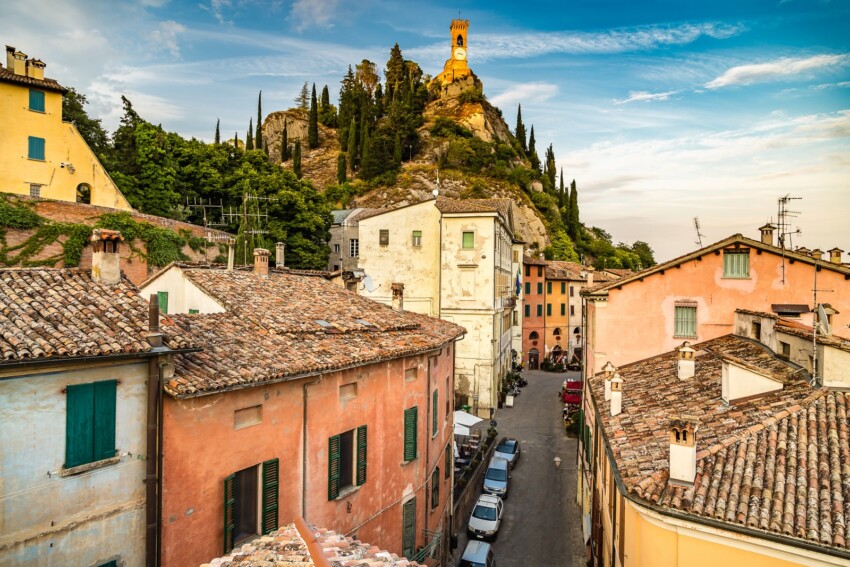
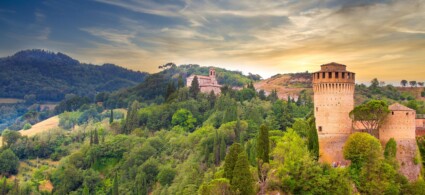
Nestled in the province of Ravenna, amongst the hills of the Vena del Gesso Romagnola Regional Park, Brisighella is one of the most captivating villages in Emilia-Romagna, famous for its rich history and evocative landscape. During the medieval period, Brisighella became a centre of defence and territorial control, and its history became intrinsically tied to that of noble families, most notably the Manfredi. They left behind one of Brisighella’s most emblematic testaments, namely the Rocca Manfrediana. The fortress is an imposing 13th-century stronghold that dominates the village from a gypsum pinnacle and offers breathtaking panoramic views across the surrounding valley.
Not far from the fortress stands the Monticino Sanctuary, another place of great spiritual charm that was built in the 18th century to house a sacred image of the Madonna and Child dating from 1626. Another unmissable attraction is the Clock Tower which stands on another selenite pinnacle surrounded by olive groves and vineyards and is considered an icon of Brisighella. Originally a watchtower here, part of the city’s ancient defensive system, it was only in the 19th century that this tower was rebuilt and the clock mechanism was installed, which we can now admire.
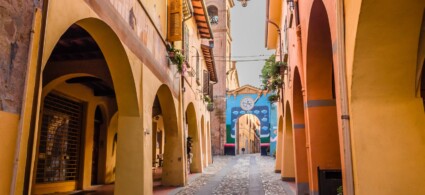
Among the distinctive features that make Brisighella unique is the Via degli Asini (Donkey Road), an elevated and covered street that was once used by mules to transport gypsum extracted from nearby quarries. With its irregular arches and colourful windows, this road represents a true journey through time and an extraordinary example of medieval architecture.
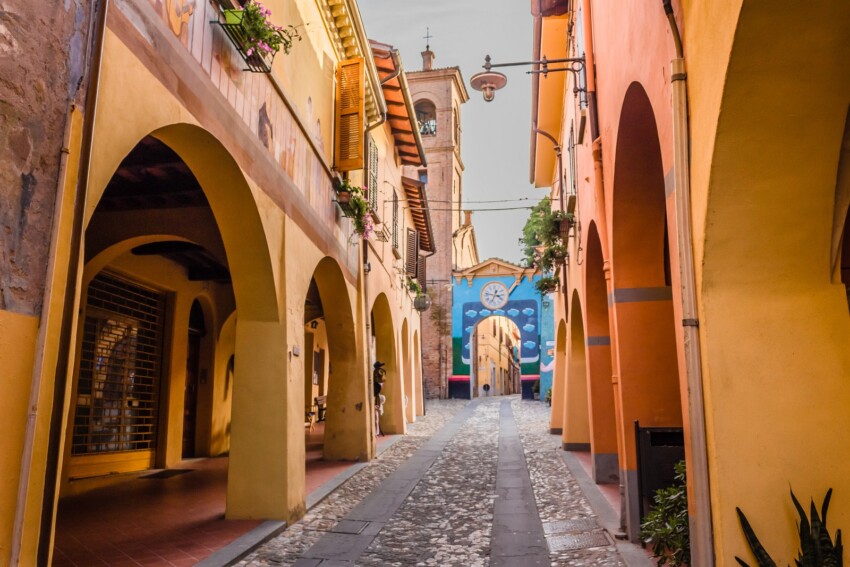
Dozza is a charming little town in the province of Bologna known for being one of the most historic yet also most artistic villages in Emilia-Romagna, with the streets of its centre filled with murals and works of art. Dozza’s history dates back to Roman times, but it was during the medieval period that the village was fortified as it was considered an important point of defence and territorial control. A symbol of this is undoubtedly the Castello di Dozza, built in the 13th century as a military fortress but subsequently modified over time to become a noble residence.
In addition to historic buildings, Dozza’s streets feature colourful houses and murals that make the town a veritable open-air art gallery. Over the years, indeed, the walls of houses in Dozza’s centre have been beautified with murals and drawings created by artists and this activity continues thanks to the Biennial of the Painted Wall. For this reason, Dozza is best discovered by wandering through the alleyways of the centre without a specific destination or map, simply curious to admire all its beautiful murals.
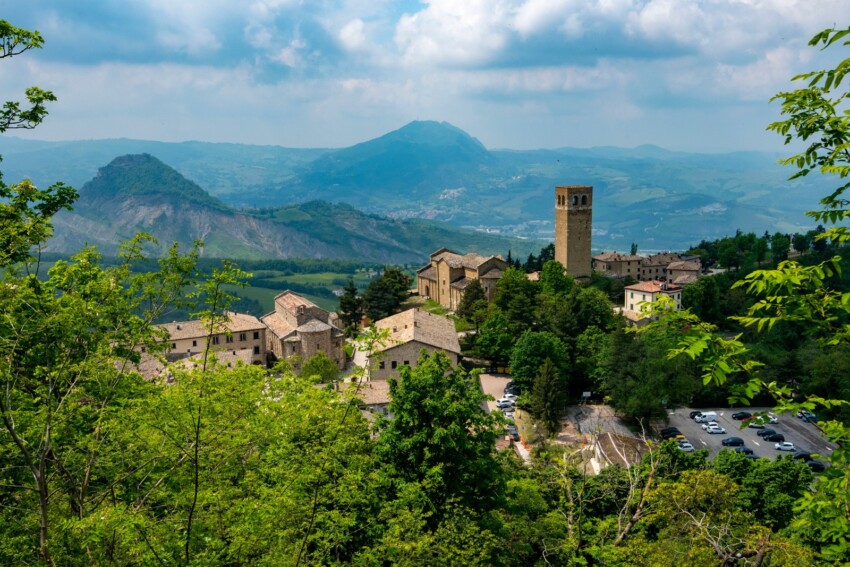
In the province of Rimini, perched on a limestone rock dominating the Marecchia valley, stands the evocative village of San Leo, famous for its imposing fortress and its history rich in events. The position perched on a crag, the narrow cobbled streets, the well-preserved historic buildings and the breathtaking panoramic views all contribute to creating an atmosphere that seems suspended in time. This village, which is part of the “Most Beautiful Villages in Italy” circuit, is an unmissable destination for those wishing to explore the Romagna hinterland and immerse themselves in an authentic medieval atmosphere.
During the Early Middle Ages the village took its name from San Leone, a Dalmatian monk who, according to legend, evangelised the region and later became the first bishop of the area. Over time, San Leo became an important religious and military centre and the village was contested between the Montefeltro and Malatesta families, two powerful dynasties who frequently clashed for its control. It was in this context that the Rocca di San Leo was strengthened, a defensive structure built as early as the 10th century but later expanded many times. In the 15th century, under the rule of Duke Federico da Montefeltro, it became one of the most imposing and impregnable fortresses in Italy thanks to the work of architect Francesco di Giorgio Martini.
In the 19th century the Rocca was converted into a prison where notorious figures such as Felice Orsini and Count Cagliostro were held, further adding to the allure of the place. Today the Fort of San Leo houses a museum inside that tells the story of the fortress and the city; from here you can also enjoy a breathtaking panoramic view of the village, the surrounding territory and Monte Titano. Walking through the streets of the village, a visit is also worthwhile to the Palazzo Mediceo dating from the 16th century and the Civic Tower which was once part of the city’s defensive system. Moreover, it should be noted that the village of San Leo is also renowned for the Pieve di Santa Maria Assunta, one of the most ancient and fascinating Romanesque churches in Emilia-Romagna.
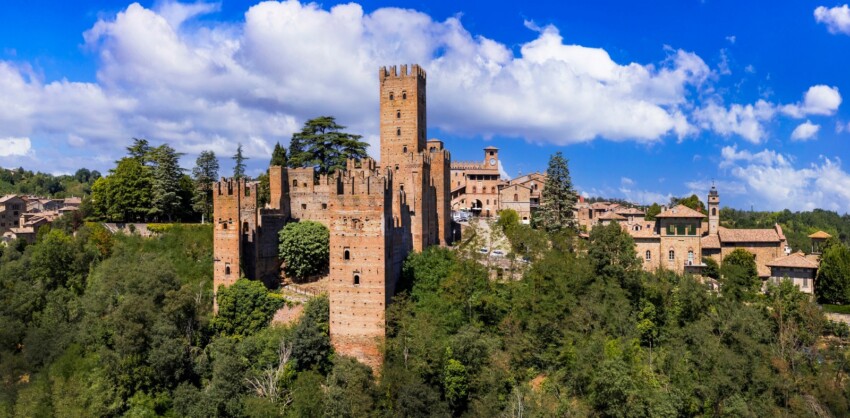
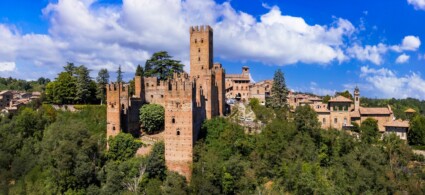
Castell’Arquato is a fascinating village nestled among the hills of the Val d’Arda in the province of Piacenza, known for its historic buildings and its perfect state of preservation. The beauty of this town has earned it a place both in the “Most Beautiful Villages in Italy” circuit and among the Orange Flags of the Italian Touring Club. Castell’Arquato has always been an important centre both defensively and religiously thanks to its strategic position on the summit of a hill overlooking the Val d’Arda. In the Middle Ages, Castell’Arquato played a pivotal role as a transit point for pilgrims and merchants located along important communication routes, such as the Way of the Monasteries that connected the Paduan plain to Lunigiana.
Among the main attractions stands the Rocca Viscontea, an imposing fortress built in the 14th century that offers a spectacular panoramic view of the valley below, and the Palazzo del Podestà built as a residence but later converted to serve as the seat of the Podestà. Also not to be missed is a visit to the Collegiata di Santa Maria Assunta, a splendid Romanesque church dating from the 12th century but later modified, which preserves inside works of great artistic value.
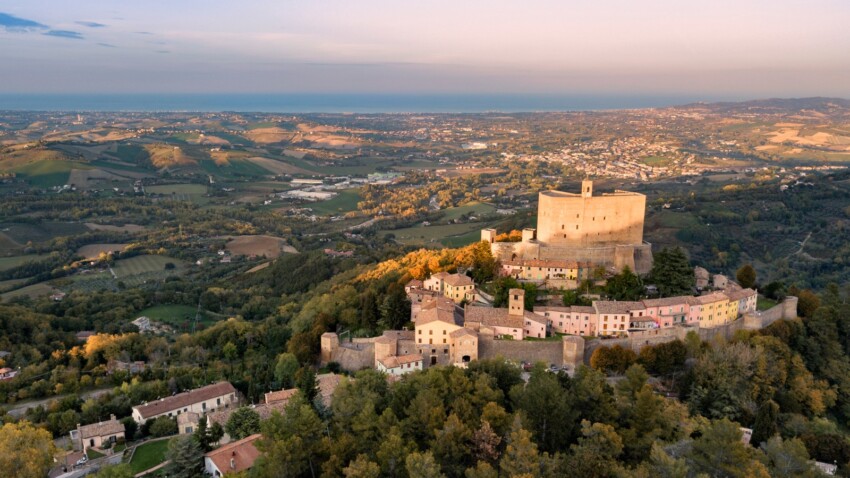
Montefiore Conca is a charming village in the province of Rimini nestled among the hills of the Val Conca and represents one of the hidden gems of the Emilia-Romagna region. This medieval village is known for its imposing fortress and its gastronomic traditions which include products such as olive oil and Sangiovese wine. The history of Montefiore Conca, like that of other localities in the area, is also linked to the Malatesta family who ruled the territory and transformed the small pre-existing fortress into a noble residence. Under the rule of the Malatesta, Montefiore Conca experienced a period of great growth: its strategic position meant that it was transformed into an important centre of control and defence.
The Rocca di Montefiore, which is one of the most fascinating examples of medieval military architecture, not only tells part of the history of this territory but also offers a breathtaking view that extends all the way to the Adriatic Sea. The village still preserves much of the city walls built to protect the town from enemy attacks and walking along the walls, you can enjoy spectacular views of the surrounding hills and the other small villages that dot the territory. Once you pass through the medieval walls you enter the village characterised by cobbled streets, stone houses and the remains of ancient buildings. Not to be missed is a visit to the Church of San Paolo, a Romanesque church with a simple yet evocative façade that houses inside a series of 14th-century frescoes of great artistic value.
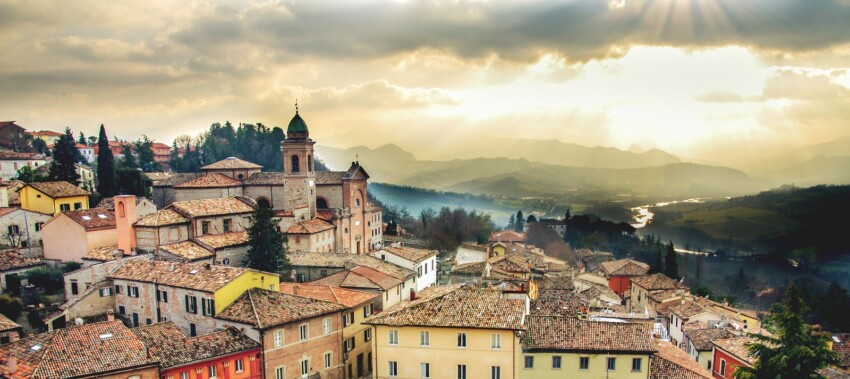
Another evocative village in the province of Rimini is Verucchio, which rises among the hills of the Valmarecchia and is the ideal destination for a stay centred on history and relaxation just steps away from the Republic of San Marino. Included in the “Most Beautiful Villages in Italy” circuit, Verucchio is a town that has preserved its medieval layout and extends between two hills once dominated by imposing fortresses: that of Passerello, where today stand the ruins of a convent, and that of Sasso, where the Rocca Malatestiana is located.
Finds uncovered in the area testify that this territory was inhabited since Etruscan times, but the village reached its greatest splendour in the Middle Ages, when it became an important political and military centre under the Malatesta family. This noble house built in Verucchio the Rocca Malatestiana, an imposing fortress that is considered one of the best preserved among those built by the Malatesta.
The heart of the village has always been Piazza Malatesta where Palazzo Giungi faces, a building dating from the 17th-18th centuries, and not far from this stands the Collegiata di San Martino built in 1863 to a design by architects Antonio Tondini and Filippo Moro. Other notable attractions in the town are the Romanesque Pieve di San Martino, dating from around the 10th century, and the Franciscan Convent, considered one of the oldest in Italy which is said to have been founded by St Francis himself.
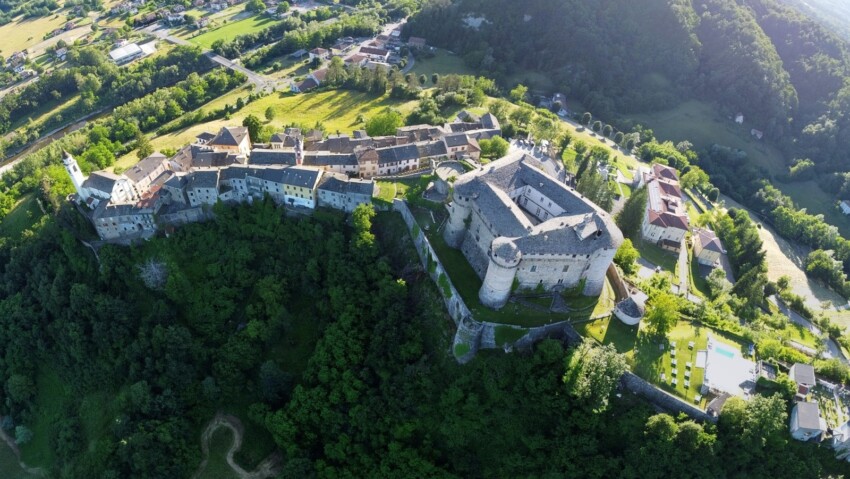
Among the hills of the Parma Apennines stands Compiano, a fascinating village known for its history, well-preserved medieval layout and for having been part of the State of the Landi, a realm that lasted almost half a century. Included in the “Most Beautiful Villages in Italy” circuit, Compiano was ruled by various families, among them the Landi who made it an important political, economic and military centre between the 13th and 17th centuries. Dating from that period is the Castello di Compiano, a majestic fortress built on a rocky spur that dominates the Taro Valley.
The Fortress tells the story of the various successive dominations such as the Landi, the Visconti and the Farnese and much of the events related to this territory. Inside the Castle is also the Museum of Freemasonry which houses a rich collection of objects and documents linked to the history of freemasonry in Italy. Other notable attractions within the fortified centre are the various religious buildings present and built between the 14th and 17th centuries. In particular, not to be missed is a visit to the Church of San Giovanni Battista, which dates from the 17th century and features richly decorated interiors, and the Church of Sant’Antonio Abate dating from the late 15th century.
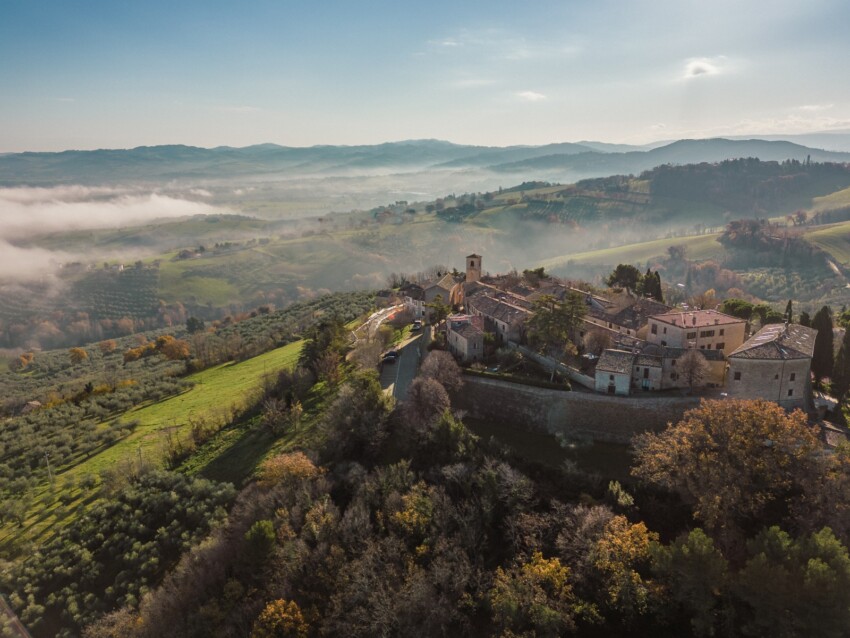
Nestled amongst the hills of Val Conca lies Montegridolfo, a charming village in the province of Rimini where the Malatesta family built an imposing fortress to defend themselves against potential attacks from the Marche territories. To this day, Montegridolfo stretches between two valleys: the Conca Valley on the Romagna side and the Foglia Valley on the Marche side.
The village’s origins date back to the 10th century when the strategic importance of this territory became evident, but it was Galeotto Malatesta who in the 14th century decided to construct a fortress surrounded by impressive walls that enclosed a small village within. Today the town is still encircled by high walls, and the municipal administration is housed within Montegridolfo’s castle.
Other buildings worth visiting are the Church of San Rocco, a splendid church that houses important frescoes, and the Sanctuary of the Blessed Virgin of Graces, an important place of worship and pilgrimage. Finally, outside the walls of Montegridolfo, don’t miss the Museo della Linea Gotica (Gothic Line Museum), which tells the story of this territory’s role during the Second World War.
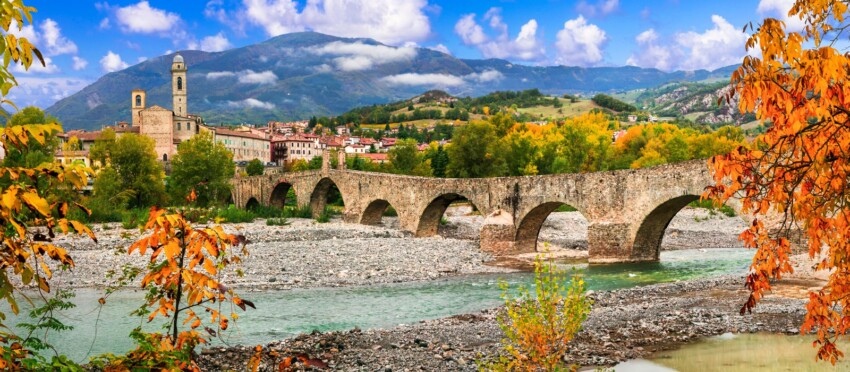
In the province of Piacenza, nestled among the hills of Val Trebbia, stands Bobbio, an enchanting village renowned for its history linked to the Abbey of San Colombano, founded in the 7th century. This small town reached its peak during the Middle Ages, when it became an important religious and cultural site following the establishment of an abbey under the guidance of Irish monk San Colombano. This monastic complex, which still houses a rich collection of ancient manuscripts and artworks, was a celebrated cultural centre for many years and now contains the Abbey Museum and the Civic Museum.
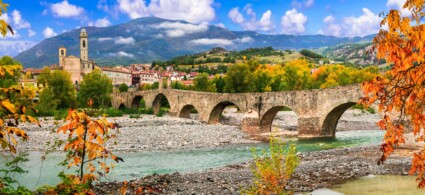
Other notable attractions in the town include the Ponte Gobbo (Hunchback Bridge), an ancient Roman bridge spanning the Trebbia river, and the Cathedral of Bobbio dedicated to Santa Maria Assunta, which served as the burial place of many bishops. Also worth visiting is the Castello Malaspina-Dal Verme, an impressive fortress built atop a hilltop in the 14th century by the Malaspina family and later enlarged by the Dal Verme family. The manor is renowned for being part of the circuit of Castles of the Duchy of Parma, Piacenza and Pontremoli and offers breathtaking views of the surrounding territories.
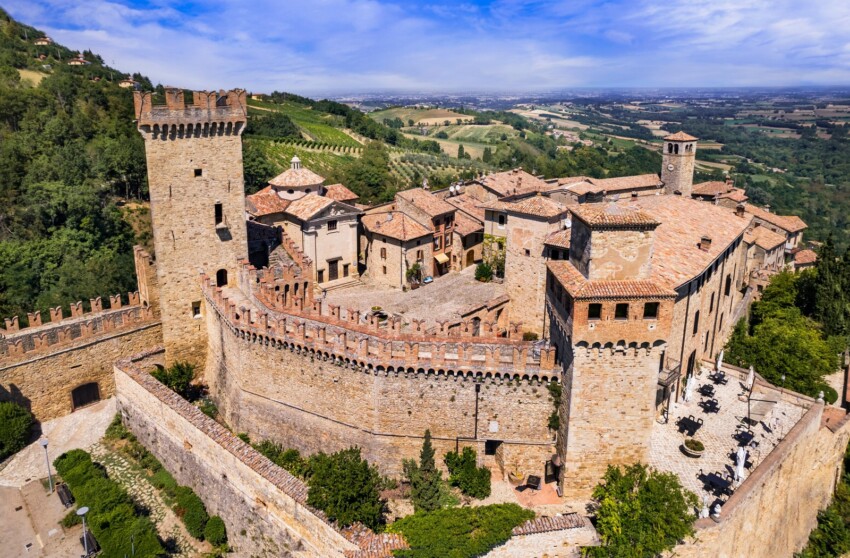
Vigoleno is a hamlet of the municipality of Vernasca, in the province of Piacenza, nestled amongst the hills of Val d’Arda and renowned for its small yet captivating fortified village. During the Middle Ages, Vigoleno developed around a defensive stronghold built in a strategic position that allowed control of the Ongina valley. Testament to that period is the Castello di Vigoleno, a well-preserved medieval fortress that dominates the town’s skyline with its crenellated walls, imposing towers and ramparts.
Inside the castle you’ll find rooms decorated with frescoes and furnishings that recount the history of this village over the centuries, whilst outside it’s possible to walk along much of the rampart. The manor also became an important cultural hub in the 20th century thanks to the Duchess Maria Ruspoli de Gramont, who owned the fortress from 1921 to 1935 and attracted important figures such as Gabriele D’Annunzio and Max Ernst.
Within the walls also stands the Church of San Giorgio, a splendid Romanesque parish church dating back to the 11th century and considered an excellent example of medieval religious architecture. Due to its atmosphere and excellent state of preservation, Vigoleno is among “Italy’s Most Beautiful Villages” and has been awarded the Orange Flag of the Italian Touring Club.
In the following map you can see the location of the main places of interest mentioned in this article.












 Hotel
Hotel  Budget accommodations
  Apartments
  Family Hotel
  Luxury Hotel
  Resorts