Holiday Inn Express Reggio Emilia by IHG
Reggio Emilia - Via Meuccio Ruini 7
Book now
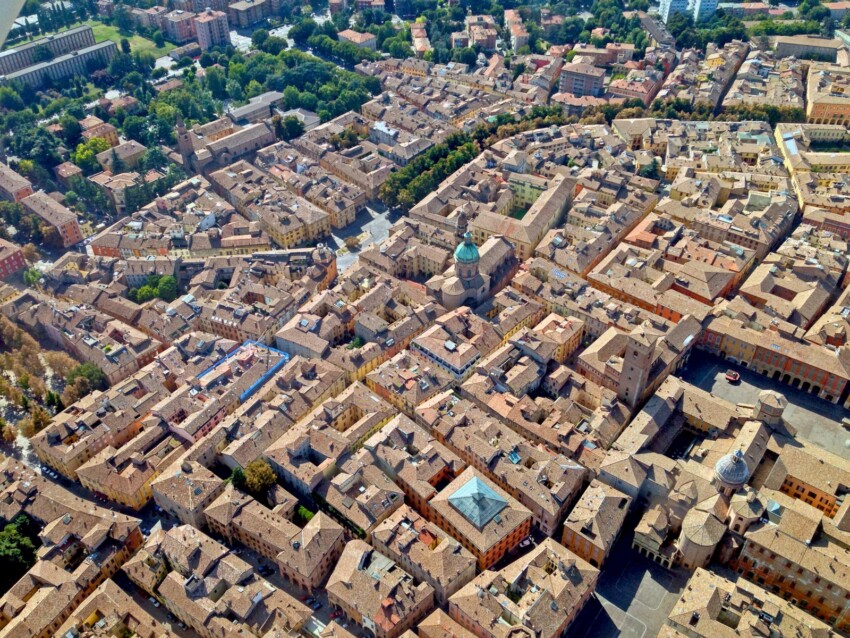
Renowned for its rich history, culinary and cultural traditions, and its significant role in the Italian Risorgimento, Reggio nell’Emilia is a fascinating destination for anyone wanting to discover authentic Emilian beauty. The city sits in a strategic position between Parma and Modena, offering visitors a unique blend of historic architecture, contemporary art and natural landscapes. Founded by the Romans in the 2nd century BC at the behest of the consul Marcus Aemilius Lepidus, who named it “Regium Lepidi”, the city lies along the famous via Emilia, a consular road that connected Piacenza with Rimini.
Following the fall of the Western Roman Empire, the city was first conquered by the Lombards and then became the capital of the Duchy of Reggio, experiencing the rule of important families such as the Este and the Gonzaga. Reggio Emilia is also famous for being the birthplace of the Italian flag and for playing a leading role both in the Risorgimento and during the Resistance in the years of the Second World War. Today, Reggio nell’Emilia is known as a peaceful, welcoming city, celebrated not only for its historic monuments but also for its gastronomy, which boasts products such as the renowned Parmigiano Reggiano.
Reggio nell’Emilia offers a wide range of sites and attractions that tell much of the local history, from historic monuments to museums, from parks to lively piazzas. The city is easy to navigate on foot, wandering through its arcaded streets surrounded by ancient churches, Renaissance palaces and important works of art.
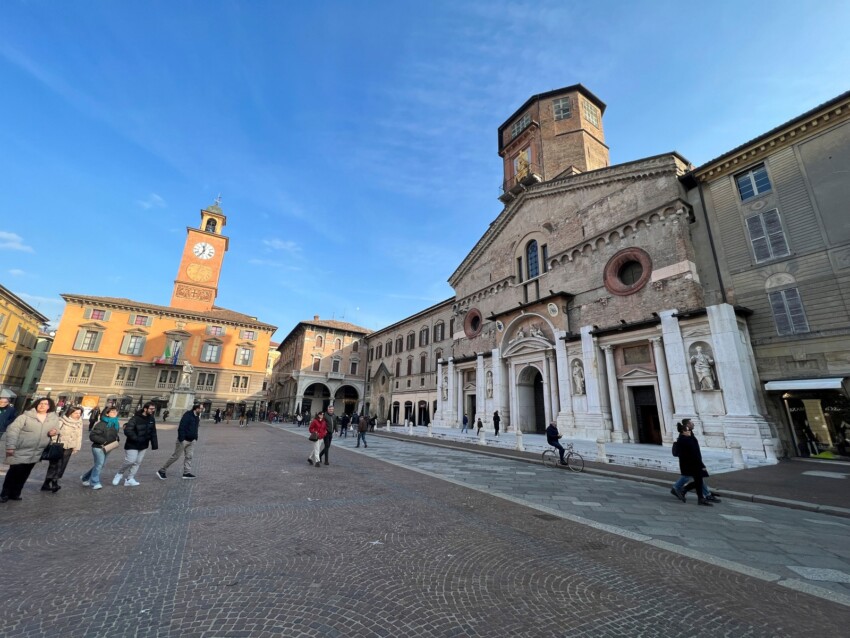
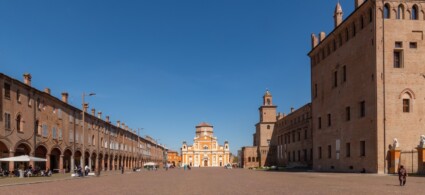
For years the hub of civic political and social life, Piazza Prampolini is certainly a good starting point for discovering Reggio Emilia, as some of the city’s main historic buildings look out onto it, along with cafés, restaurants and shops. Also known as Piazza Grande, Piazza Prampolini has been called by this name since 1945 in honour of Camillo Prampolini (1859–1930), a Reggian socialist politician.
All around the piazza stand important palaces such as the Palazzo del Monte di Pietà with its Clock Tower, the Palazzo Comunale, the Baptistry and the city’s Cathedral, whilst at the centre rises the statue of the Crostolo, representing the Crostolo stream, a tributary of the Po that winds for about 50 km through the province of Reggio.
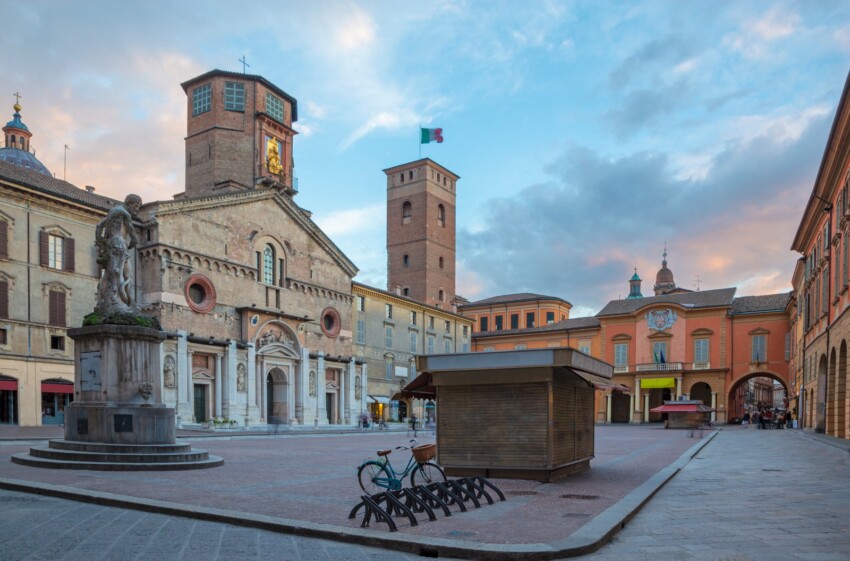
The Cathedral of Reggio Emilia, dedicated to Santa Maria Assunta, is a masterpiece of Romanesque architecture built in the 12th century on a site that already hosted a small church from the 5th century. The religious building features an imposing façade designed by Prospero Sogari, known as Il Clemente, which houses in its lower section niches with statues of Grisante, Venerio, Daria and Gioconda, the four patron saints of the city.
The upper part of the façade is thought to have been rebuilt in the 13th century by Malaguzzi, when frescoes were also created that are now preserved in the Diocesan Museum. The interior features a Latin cross layout with three naves, three apses and three domes, of which one large dome rises at the centre and two smaller ones in the apsidal chapels. During your visit, you’ll notice sculptures and frescoes by important Reggian artists such as Bartolomeo Spani and Prospero Sogari, and the precious high altar.
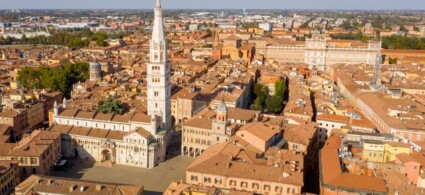
Piazza San Prospero, also called “the small piazza”, is located right next to Piazza Prampolini and is connected to it by a small arcaded alley called via del Broletto. The piazza has a rectangular shape with three arcaded sides that house shops and bars, whilst the fourth side features the Basilica of San Prospero flanked by an octagonal bell tower. The traditional city market is held twice a week in this piazza and it is often considered the ideal place to observe the daily life of the city.
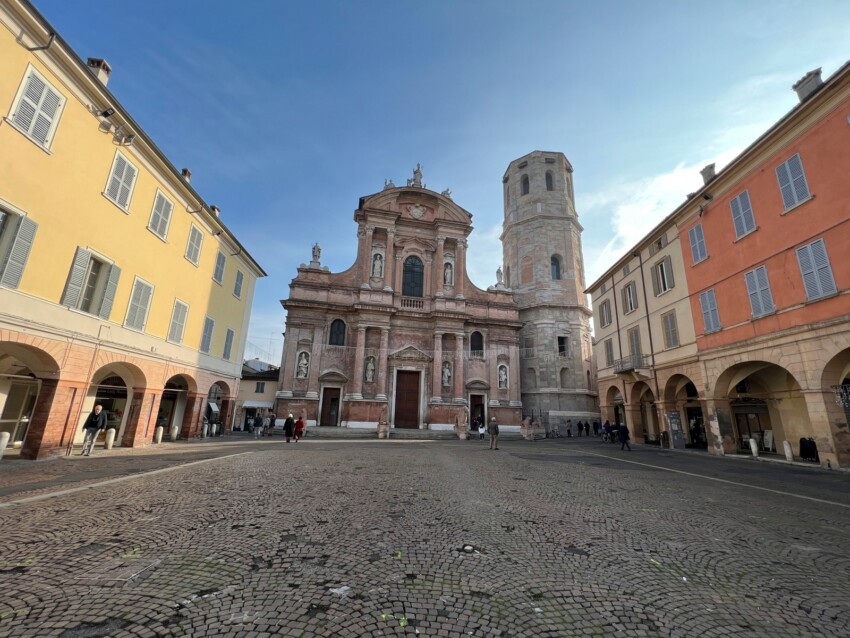
Built around the 17th century, the Basilica of San Prospero is another famous place of worship in Reggio Emilia and an important testimony to Emilian Baroque. The Basilica is dedicated to San Prospero, bishop of Reggio Emilia in the 5th century, and also patron saint of the city, as he is said to have saved it from the invasion of Attila’s Huns.
Externally, the building features in its forecourt six characteristic lions in red Verona marble, whilst the façade is adorned with eleven statues of patron saints and doctors of the Church. Next to the façade stands an octagonal bell tower which, at 60 metres in height, dominates the city skyline and is considered a symbol of Reggio. Artists such as the Pacchioni, Cristoforo Ricci known as il Rossino, Giulio Romano and Prospero Clemente worked on its creation, though it was never actually completed.
The interior boasts a Latin cross layout divided into three naves and is not only decorated with great elegance but also features frescoes by artists such as Bernardino Campi, Tommaso Laureti, Ludovico Carracci and Camillo Procaccini. In particular, the Bolognese Camillo Procaccini created a cycle of frescoes in the apsidal vault depicting the “Last Judgement”. The Basilica also houses beneath the high altar the mortal remains of San Prospero, which were previously kept in a monastery dedicated to him located outside the city walls.
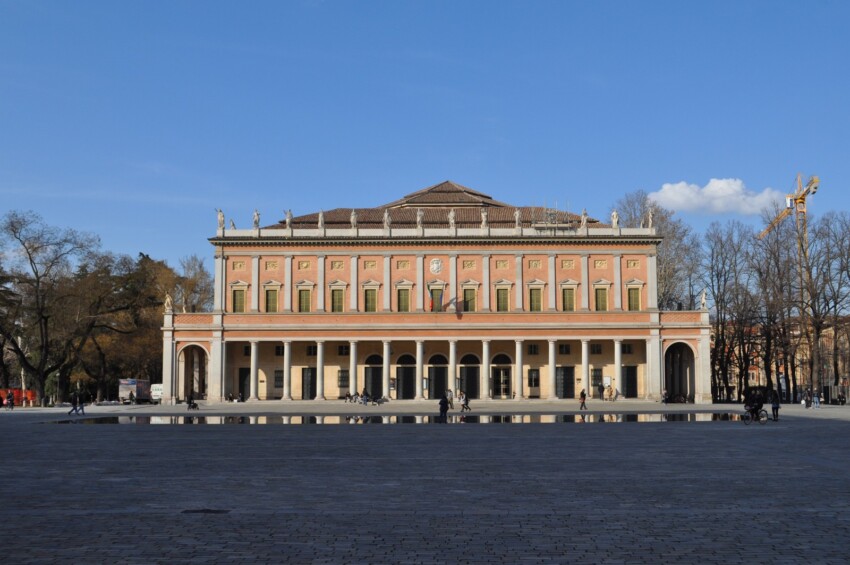
Inaugurated in 1857, the Teatro Romolo Valli is a jewel of Italian theatrical architecture, named after the illustrious actor Romolo Valli, who was born in Reggio Emilia in 1925. The building was constructed with a neoclassical façade by architect Cesare Costa and engineer Antonio Tegani, who drew inspiration from the Grand Théâtre de Bordeaux for its design. The interior auditorium features a horseshoe-shaped layout with four tiers of boxes plus a gallery, and a ceiling finely decorated with allegorical paintings by Domenico Pellizzi, a local 19th-century artist.
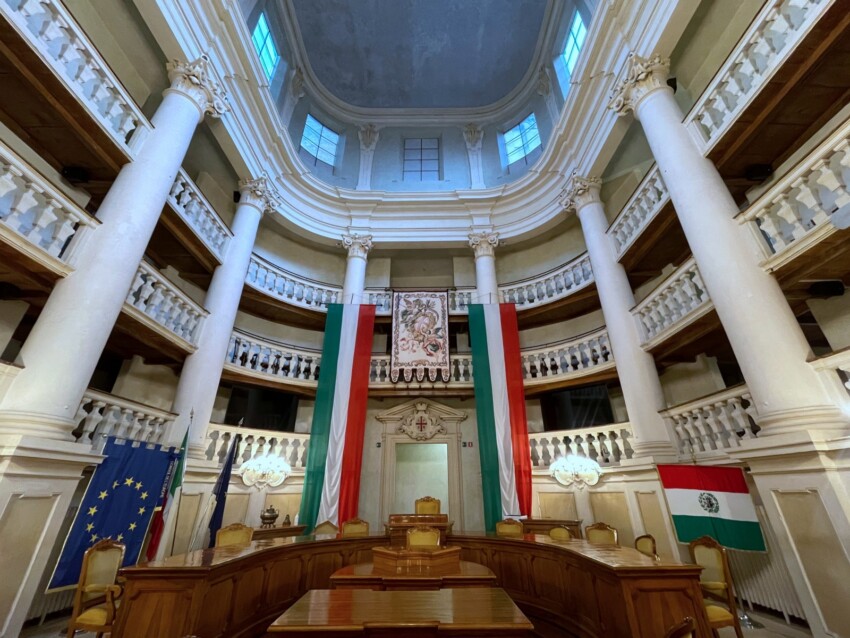
The Hall of the Tricolour is located within the Palazzo Comunale and is known as a place of great historical and symbolic importance both for Reggio Emilia and for the entire Italian nation. Reggio Emilia is indeed known as the “city of the Tricolour” because it was here that, on 7 January 1797, the Italian flag was born during the Congress of the Cispadane Republic.
On that occasion, representatives from the cities of Reggio Emilia, Modena, Bologna and Ferrara gathered here and chose the three-colour flag of green, white and red, representing the unity and independence of Italian cities. Near this Hall is now the Museum of the Tricolour, which is dedicated to the history of the Italian flag from its birth in the late 18th century to Italian Unification.
The Basilica of the Madonna Ghiara (or Temple of the Blessed Virgin of Ghiara) has for centuries been one of the city’s most important churches as it has venerated an icon of the Blessed Virgin since the 14th century, which is said to have performed several miracles. Towards the end of the 16th century, it was decided to expand the small church that housed the icon to build a larger structure worthy of welcoming all the faithful. For this occasion, Duke Alfonso II d’Este had the building designed by Alessandro Balbi of Ferrara, who was highly esteemed by the Este family.
In 1619 the church was consecrated and shortly afterwards, with money collected from donations, the famous work “Crucifixion” by Guercino was acquired and displayed. The interior of the church, which has a Greek cross layout and three naves, is decorated with several masterpieces created in the 17th century by artists such as Ludovico Carracci, Alessandro Tiarini, Carlo Bononi and Carlo Caliari (son of Veronese).
The cloisters of San Pietro are part of a monastic complex built in the 16th century by Benedictine monks which, after being used for various purposes, now host exhibitions, performances and cultural events. A visit to this complex, which is considered an oasis of peace and tranquillity in the heart of Reggio Emilia, includes the small cloister and the large cloister, two splendid architectural works. The small cloister, built according to Renaissance canons, is square in shape, striking for its simplicity and features a well at its centre. The large cloister, built between 1541 and 1622 by architect Giulio Romano, impresses with its monumentality featuring two orders of Doric columns and on the upper floor niches decorated with statues of saints.
The Parmeggiani Gallery is a building commissioned in central Reggio Emilia by art dealer Luigi Parmeggiani (1860–1945) from 1925 onwards to house his extensive collection of modern and contemporary art. Externally the palace boasts an unusual medieval-inspired architecture with spires and Gothic decorations reflecting Parmeggiani’s eclectic taste and personality.
The façade of the building features 7 monsters as well as busts of four renowned artists—Raphael, Michelangelo, Leonardo and Cellini—which are intended to serve as guardians of the building. Inside are displayed various works of art, sculptures, objects and installations created by Italian, Spanish, Flemish and French artists such as the Portrait of Prince Carlos of Bourbon by Herrera Barnuevo and the Blessing Saviour created by El Greco.
Everyone knows the famous fashion house Max Mara, but few know that it has its headquarters right in Reggio Emilia, as it was founded here in 1951 by Achille Maramotti. In the city, in the space that previously housed a company office, founder Maramotti decided to open an exhibition space dedicated to contemporary art. Here you’ll find more than 200 works of contemporary art created from 1945 onwards, following the main artistic trends of the 20th century in Italy and internationally.
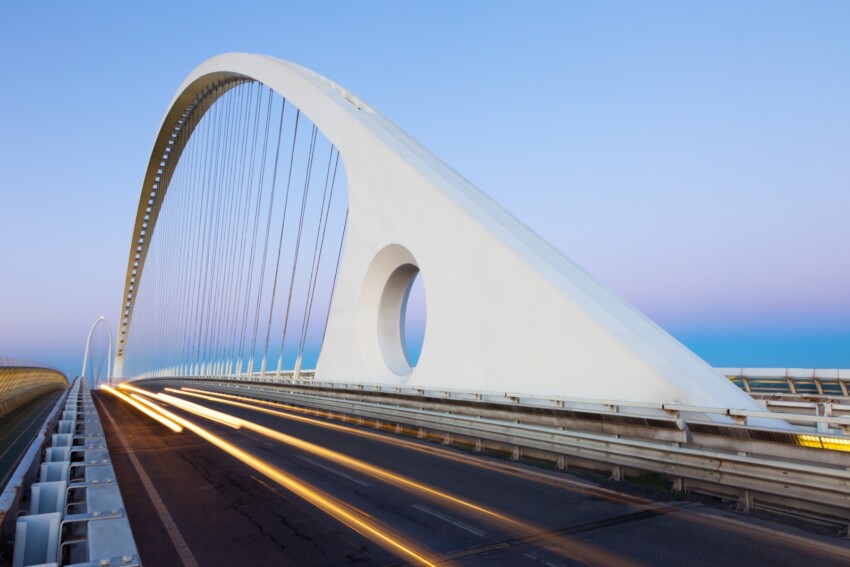
In Reggio Emilia you can admire four infrastructures designed by Spanish architect and engineer Santiago Calatrava, who has realised several projects in Italy. In the northern part of the city, clearly visible from the A1 motorway, three of Calatrava’s bridges have been built as part of a redevelopment project of the motorway exit and Mediopadana high-speed station area.
A large central arch bridge spanning the motorway was constructed here, along with two lateral cable-stayed bridges which together are called “The Sails”. Calatrava’s other major project concerns the Reggio Emilia Mediopadana Station11, which sits on the Milan-Bologna high-speed railway line, where a modern building with futuristic design known as “wave-shaped” was constructed.
The Popolo Park, also known as the public gardens of Reggio Emilia, is a green area located in the city centre where the ancient Ducal Citadel once stood. In the mid-19th century this was demolished to make way for a garden inspired by neoclassical design, created to a project by Giuseppe Balzaretto, a renowned architect and artist who designed gardens and parks throughout the peninsula.
Popolo Park in Reggio was characterised from the outset by orderly pathways, fountains, statues and centuries-old trees, and was later expanded in 1928 to provide more green spaces. Among the most important specimens of trees present inside are also some centennial cedars of Lebanon.
The new Mauriziano Palace, known as the Casino dell’Ariosto, is a Reggio Emilia building where poet Ludovico Ariosto stayed during his childhood, which is also mentioned in his Satires. The name Mauriziano derives from the nearby church of San Maurizio, which is still part of the large complex. Access to the site is through a large Roman arch in terracotta with a single opening built in the 16th century.
The main palace, which was originally built in the 14th century as a convent for Benedictine nuns, was later transformed into a typical Renaissance villa with a square base layout. Around the entire property extends a large green park of approximately 3.6 hectares, crossed by the main tree-lined avenue leading to the entrance of the residence.
In the following map you can see the location of the main places of interest mentioned in this article.
Reggio nell’Emilia is a welcoming, orderly and people-friendly town with a wide range of accommodation options, from starred hotels to bed and breakfasts, apartments and holiday lets. The historic centre is undoubtedly the best place to stay, as most points of interest, as well as shops and restaurants, are within walking distance. For those seeking a more rural retreat, we recommend one of the properties scattered throughout the Reggio countryside.
Reggio nell’Emilia is easily accessible by car from various Italian cities thanks to the motorway network. The town can be reached via the A1 motorway (Reggio Emilia exit), which connects Milan to Naples via Bologna, or via the SS9 Via Emilia state road, which links Reggio Emilia with the nearby towns of Parma and Modena.
Alternatively, you can travel by train, as the town is served by two main stations: Reggio Emilia station in the city centre and Reggio Emilia Mediopadana station, approximately 4 km from the centre. Reggio Emilia station offers connections to major Emilia towns such as Guastalla, Sassuolo and Bologna, while Mediopadana station primarily serves high-speed rail services. Thanks to this infrastructure, trains from Bologna take approximately 30 minutes, whilst from Milan take roughly an hour and a half. The nearest airport is Giuseppe Verdi airport in Parma, about 40 km away, with Bologna Guglielmo Marconi airport as an alternative option, approximately 70 km distant.
What's the weather at Reggio Emilia? Below are the temperatures and the weather forecast at Reggio Emilia for the next few days.
Reggio nell'Emilia is a peaceful town ideally positioned between Parma and Modena, making it an excellent base from which to explore other cities throughout the region. Reggio Emilia lies around 35 km from Modena, 80 km north of Bologna and 115 km from Ferrara.
 Hotel
Hotel  Budget accommodations
  Apartments
  Family Hotel
  Luxury Hotel
  Resorts