B&B Hotel Faenza
Faenza - Via San Silvestro 171
Book now
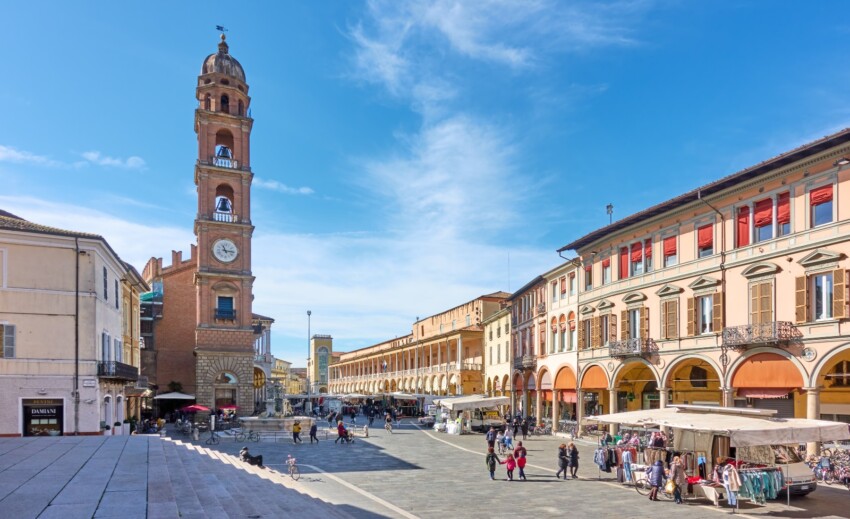
Recognised internationally for its ceramic tradition, Faenza is a city of ancient origins and great historical and cultural significance that houses important artistic and architectural treasures. Faenza’s history traces its roots back to Roman times when it was known as Faventia and served as an important economic and commercial centre along the Via Emilia, one of the principal communication routes of the Roman Empire. During the Middle Ages, Faenza was dominated by various noble families, including the Manfredi, who ruled the city from the 14th to 16th centuries and contributed significantly to its artistic and cultural development.
It was during the Renaissance in particular that Faenza saw the flourishing of a prestigious ceramic school that is still appreciated worldwide today, so much so that majolica, thanks to the fame of the local manufacture, is known around the world as “faience”, that is, “Faenza”. Over the centuries, the city was enriched with numerous important architectural works and, particularly between the 18th and 19th centuries, thanks to the work of architects such as Giuseppe Pistocchi, Giovanni Antonio Antolini and Pietro Tomba, it became a leading player in neoclassicism on a European level. Today Faenza presents itself as a welcoming city that knows how to fascinate and captivate every visitor thanks to its artistic heritage, its ceramic tradition and its warm hospitality.
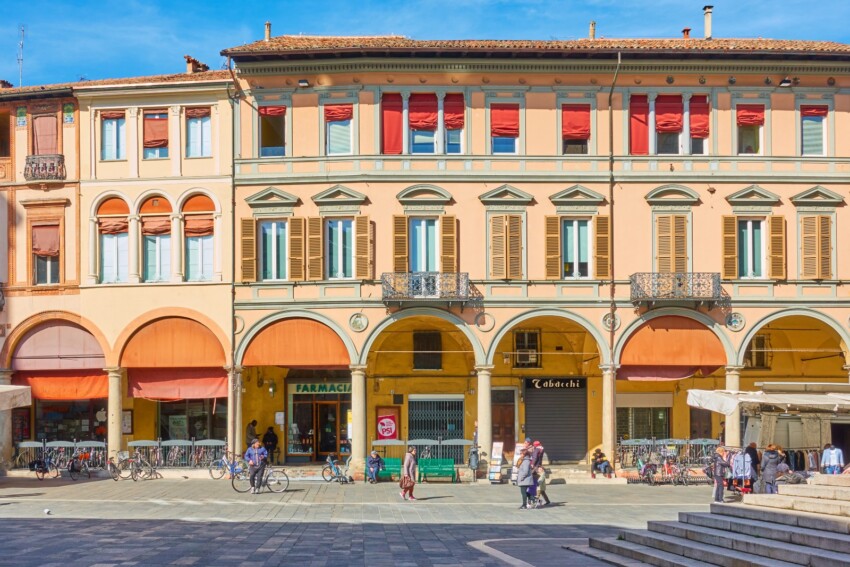
Elegant, orderly and on a human scale, Faenza is a veritable open-air museum, where every corner tells part of its centuries-old history. Walking through the streets of the centre, you’ll find numerous squares, churches and palaces that bear witness to its glorious past. The beating heart of Faenza has been represented for centuries by two main squares, Piazza del Popolo and Piazza della Libertà, which are surrounded by historic buildings of considerable importance, such as the Palazzo del Podestà and the Palazzo Comunale. Piazza del Popolo, with its rectangular shape, is dominated by the Clock Tower and the Palazzo del Podestà, built in the 13th century. Piazza della Libertà, meanwhile, is home to the majestic Cathedral of San Pietro Apostolo, an imposing Renaissance building designed by architect Giuliano da Maiano.
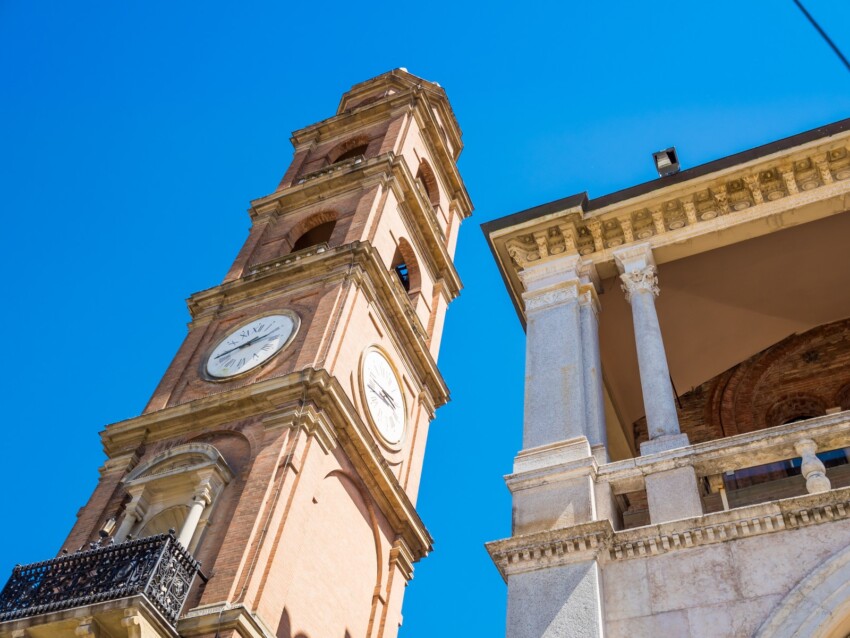
The Civic Tower, also known as the Clock Tower, stands at the entrance to Piazza del Popolo, at the intersection of the cardo and decumano of the ancient Roman Faventia, and is one of Faenza’s most distinctive and recognisable architectural symbols. The original design, attributed to Fra Domenico Paganelli, dates back to 1604 when the tower was constructed using a 16th-century rusticated stone base.
The tower has a square shape, comprising five superimposed storeys and is topped with a majestic dome. In the lower part of the Tower, within a niche protected by a wrought iron and brass balcony, is a marble statue of the Madonna and Child created by Francesco Scala in 1611.
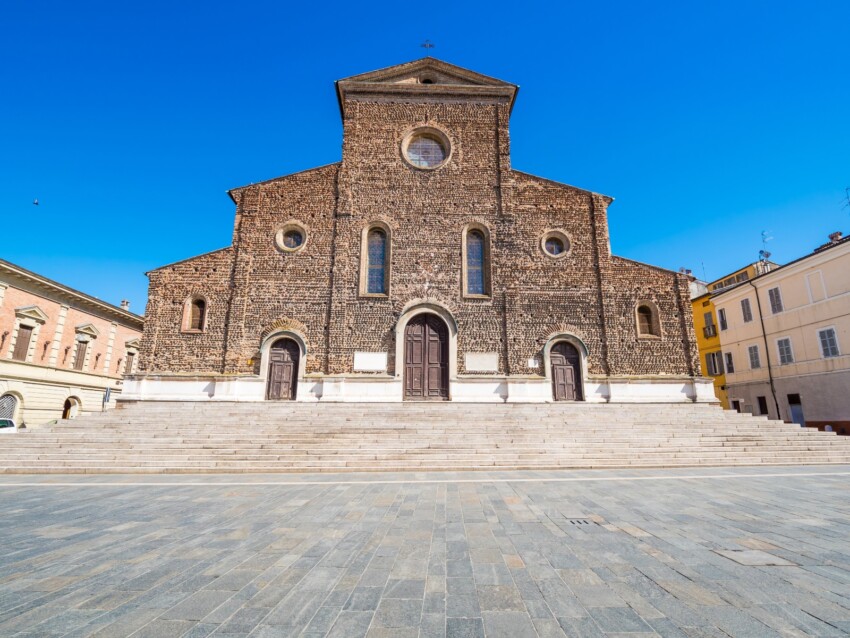
The Duomo of Faenza, commonly known as the Cathedral of San Pietro Apostolo, is one of the city’s most important religious buildings and is an extraordinary example of Renaissance architecture. It was built between 1474 and 1520, replacing a previous cathedral about which little is known and of which virtually nothing remains. The construction of the Duomo was entrusted by the Manfredi to Giuliano da Maiano, who drew inspiration from Renaissance models.
The facade of the Duomo was built in brick and only later was faced with white limestone. The interior has a Latin cross plan with three naves and richly decorated side chapels that house artworks of great value as well as the tomb of San Pier Damiano. Among the most important sculptural monuments are a wooden crucifix carved at the end of the 15th century by an unknown Northern European sculptor, and the Pala Bonaccorsi, painted by Innocenzo Francucci da Imola, still featuring its original gilded and carved frame.
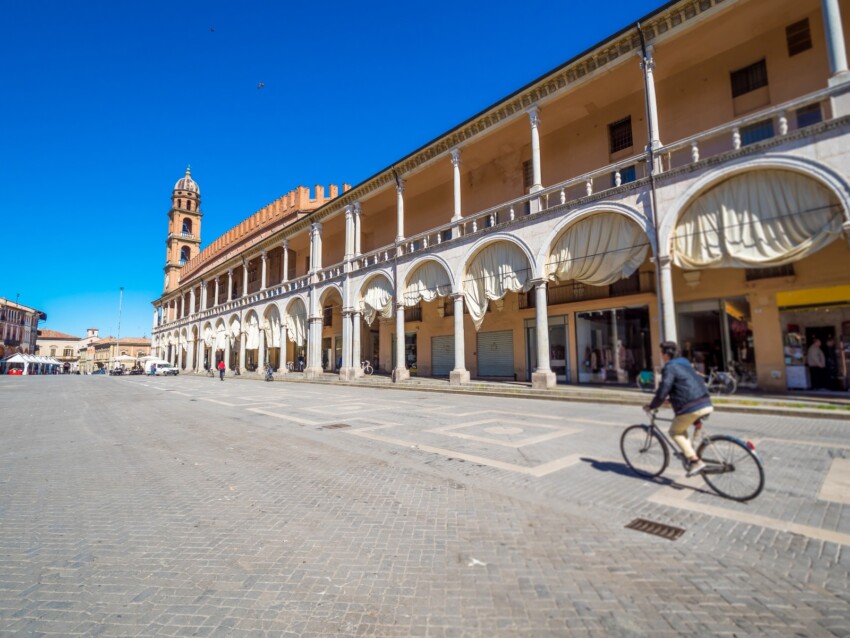
The Portico degli Orefici (Goldsmiths’ Portico), also known as the Portico dei Signori, was built opposite the Cathedral between 1604 and 1611 and has preserved intact the architecture and layout of the era, including the buildings above. The columns were made from “Varignana stone“, a highly compact type of sandstone that was quarried locally and used for prestigious buildings, with examples still visible in Faenza, Imola and Bologna. At the time of its construction, the portico housed goldsmith workshops and artisan shops, whilst today it is home to modern shops, bars and services.
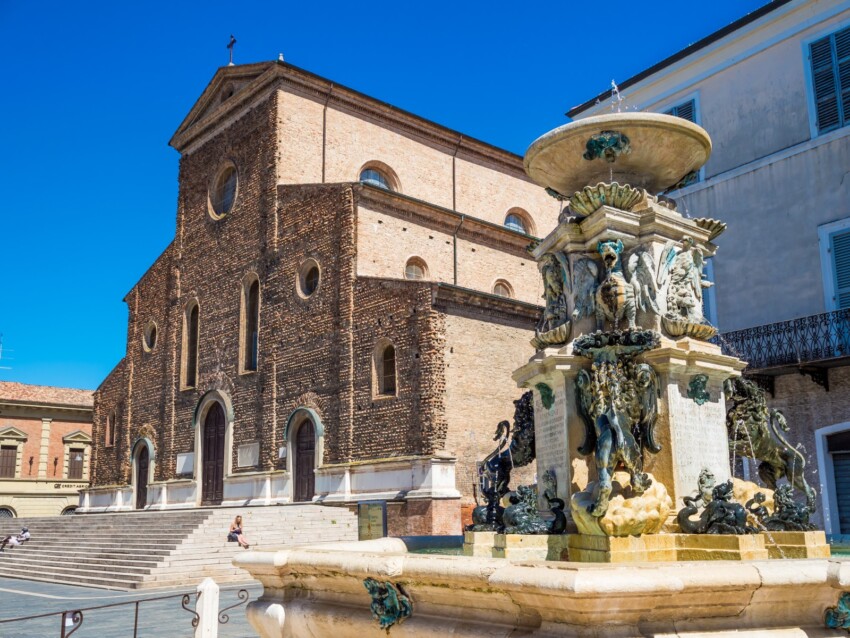
The Fontana Maggiore, also known as Faenza’s Monumental Fountain, stands in the centre of Piazza della Libertà between the Cathedral and the Clock Tower and is one of the city’s symbols. Built in the 17th century to a design by papal architect Domenico Paganelli, the fountain has been restored several times over the centuries yet its original beauty remains intact.
The fountain is characterised by a marble basin and a series of allegorical statues, notably eagles and dragons representing the heraldic emblems of Pope Paul V (Borghese) and three rampant lions representing the city’s coat of arms. Today, the Monumental Fountain is one of Faenza’s most photographed spots and a meeting point for locals and tourists alike.
The International Museum of Ceramics in Faenza is an essential stop for anyone visiting the city, as it houses one of the world’s most important and comprehensive collections of ceramics. Founded in 1908, the MIC is divided into several sections, each dedicated to a specific era or geographical region, all testament to a tradition that made Faenza famous on an international scale.
Its current collections range from ancient civilisations, such as Pre-Columbian, Oriental and Islamic ceramics, to ceramics tracing Italy’s history from the Middle Ages to the 19th century, through to 20th-century works. The MIC is not just an interesting museum venue but also a centre for the promotion and advancement of ceramics where events, activities and workshops are organised.
The Church of the Commenda was built together with the nearby Holy Sepulchre Hospice in the first half of the 12th century but subsequently underwent various alterations and restorations over time. Since the 13th century, the complex has been managed by the Knights of the Order of Saint John of Jerusalem (later of Malta), who always entrusted it to Commendatories. The nearby hospice was used to welcome pilgrims travelling to or from the Holy Land.
The most esteemed Commendatory was undoubtedly Fra Sabba da Castiglione (1480–1554), who promoted numerous restorations and invited many artists to work at the Commenda. Among the most valuable works is a large fresco in the apse, executed in 1533 by Girolamo da Treviso during his stay in Faenza.
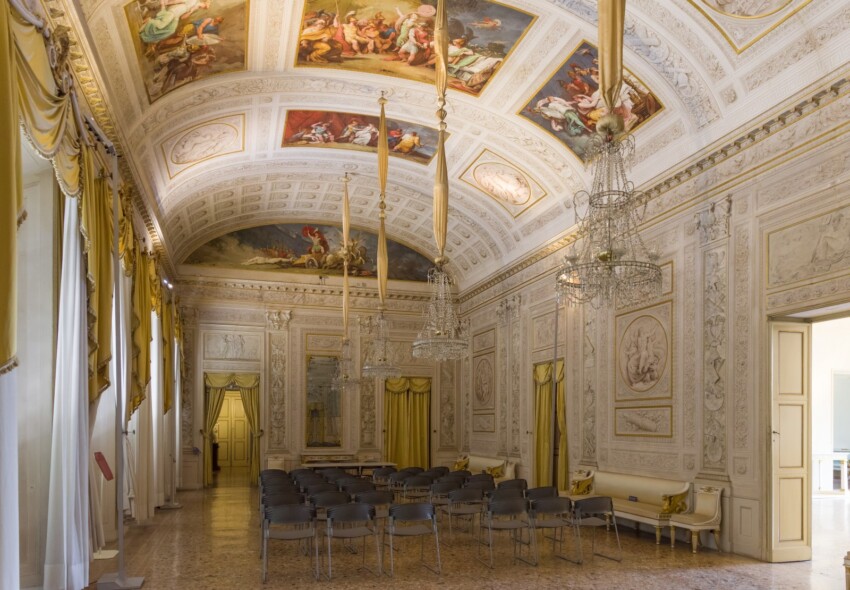
Built at the end of the 18th century by architect Giuseppe Pistocchi, Palazzo Milzetti is one of Italy’s most significant examples of neoclassical architecture and was long the residence of the noble Milzetti family. Today it houses the National Museum of the Neoclassical Era in Romagna with a rich collection of furnishings, paintings and sculptures that tell the story of life among Faenza’s nobility in the 19th century.
Every room in the palazzo is finely furnished and decorated with numerous frescoes executed by Felice Giani, one of the greatest exponents of Italian neoclassicism, and by Antonio Trentanove, an Italian sculptor who was a leading interpreter of the Baroque and Neoclassical styles in Emilia-Romagna, Tuscany and the Marche.
The Municipal Pinacoteca in Faenza is not only the city’s oldest museum but also one of the oldest in the entire Emilia-Romagna region. Its origins date back to 1797, when the Municipality of Faenza acquired a collection of artworks from artist Giuseppe Zauli (1763-1822). Later, it also came to house many paintings from convents and churches that had been suppressed following Napoleonic laws, along with other donations.
In particular, the Pinacoteca’s artistic heritage grew thanks to the acquisition of works from the Charity Congregation and a systematic acquisition campaign promoted by its first director, Federico Argnani. It now displays important works created between the 15th and 20th centuries by artists including Alfonso Lombardi, Palmezzano, Donatello, Arcangelo Resani, Giorgio de Chirico and Giorgio Morandi.
The Teatro Masini, inaugurated in 1788, is one of Emilia-Romagna’s most fascinating historic theatres and was dedicated to the celebrated Emilian tenor Angelo Masini (1844–1926). Designed by architect Giuseppe Pistocchi and decorated by Felice Giani, the theatre has been reworked several times but remains a perfect example of neoclassical architecture with elegant Rococo-style decorations.
Over the centuries, Teatro Masini has hosted numerous theatrical performances and concerts, becoming a cornerstone of Faenza’s cultural life. Even today, the theatre is fully operational and offers a rich programme of shows.
The city walls of Faenza that still surround parts of the city today were erected during the period of the Manfredi family’s rule, between 1380 and 1470, as an extension of an earlier early medieval wall circuit. Originally, the walls stretched for over 5 km and also included the Borgo Durbecco, an expansion of Faenza’s settlement beyond the Lamone river. The fortification system was characterised by 35 towers, of which 26 still remain today, and five large gates, of which only Porta delle Chiavi is still present.
In the following map you can see the location of the main places of interest mentioned in this article.
Staying in Faenza’s historic centre is the ideal choice for those wishing to immerse themselves completely in the city’s atmosphere, as it is home to elegant hotels, often housed in historic palaces, offering comfort and charm. Bed & Breakfasts and apartments are an excellent alternative for those preferring a more informal solution with a tighter budget.
In the areas surrounding Faenza you’ll find farmhouse accommodations nestled in the peaceful Romagna countryside. These properties offer the chance to enjoy a relaxing stay, away from the hustle and bustle of the city, yet only a few minutes’ drive from the historic centre.

Faenza is easily reached from various Italian locations thanks to its strategic position along important communication routes, whether by car or public transport. For those travelling by car, Faenza is well connected to the A14 motorway (Bologna-Taranto) and the A1 (Milan-Naples), which allow you to reach Faenza quickly from anywhere in the country. From Bologna, for example, Faenza can be reached in about 50 minutes by car along the A14/E45, whilst from Rimini the journey takes about an hour. The city is also located along the Via Emilia (SS9), one of the region’s main road arteries, linking Rimini to Milan via Forlì, Bologna, Modena, Reggio Emilia, Parma and Piacenza.
For those wishing to travel by train, Faenza has a railway station on the Bologna-Ancona railway line with trains connecting the city to major Italian locations, including Bologna, Florence and Ravenna. The nearest airport to Faenza is Bologna Guglielmo Marconi, located about 60 km away. From the airport, you can reach Faenza by car via the A14 motorway, or by train, taking a direct rail connection from Bologna station.
What's the weather at Faenza? Below are the temperatures and the weather forecast at Faenza for the next few days.
Strategically positioned between Bologna, Rimini and Ravenna, Faenza offers a unique experience for those seeking to immerse themselves in an atmosphere steeped in history, art and culture. The city is just 50 km from Bologna's centre, 80 km from Rimini and fewer than 40 km from Ravenna.
 Hotel
Hotel  Budget accommodations
  Apartments
  Family Hotel
  Luxury Hotel
  Resorts