Cora Hotels Leon d'Oro
CastellʼArquato - Piazza Europa 6
Book now
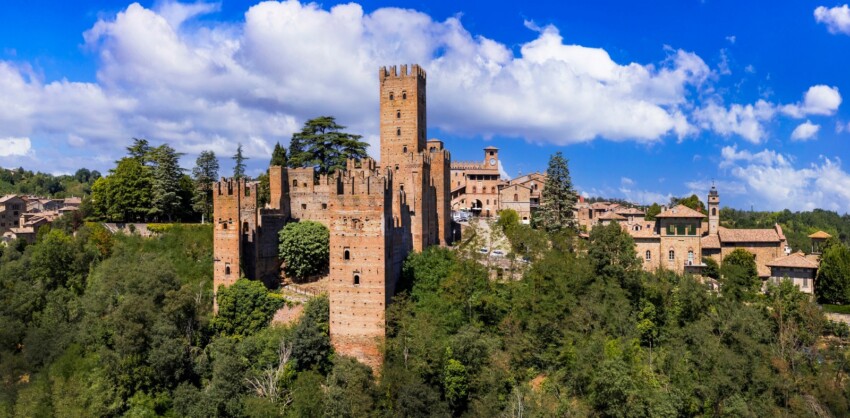
If you’re looking for a place that combines history, culture and breathtaking landscapes, then Castell’Arquato could be your perfect destination. Situated in the province of Piacenza, nestled in the hills of the Val d’Arda, this ancient village captivates visitors with its medieval charm, time-honoured traditions and numerous points of interest. Castell’Arquato’s history stretches back to ancient times, with the earliest traces of human settlement dating from the prehistoric era, but it was during the Middle Ages that the village acquired its present-day character.
It served as an important defensive and religious centre, having been built in a strategic position atop a hill commanding the Val d’Arda. Like many other towns in the region, over the centuries Castell’Arquato came under the control of various noble families, including the Visconti and the Sforza, who contributed to the construction of impressive fortifications and distinguished buildings. During the Middle Ages, Castell’Arquato played a crucial role as a stopping point for pilgrims and merchants, as it lay along important communication routes such as the Via dei Monasteri, which connected the Po Valley with Lunigiana.
Today, Castell’Arquato retains its intact medieval atmosphere, with cobbled streets, imposing towers and fascinating historic buildings that tell its long and rich story. Its beauty and state of preservation have earned it a place in the circuit of the “Most Beautiful Villages in Italy” and the Orange Flag award from the Touring Club.
The historic centre of Castell’Arquato sits on the left bank of the River Arda, whilst on the right bank a more modern residential area has developed. To fully discover Castell’Arquato, you should wander on foot through the cobbled lanes of its medieval heart and pause to admire the panoramic views across the surrounding valley.
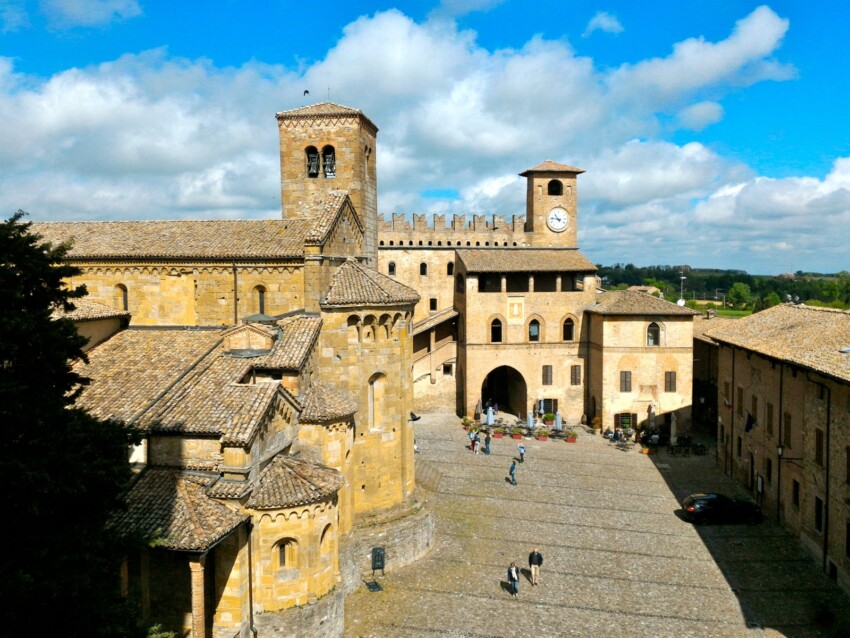
One of Castell’Arquato’s most iconic attractions is the Rocca Viscontea, an imposing fortress built in the 14th century by the Visconti family that dominates the village and offers spectacular views across the entire valley. Given its location, the fortress was designed as an important defensive structure, though as time passed its design proved inadequate for new combat techniques.
The fortress has a square floor plan with four square towers at its corners and is surrounded by a moat with defensive walls featuring two entrances and four corner towers. The fortress has preserved much of its original structure, with the keep that, at 42 metres high, dominates the entire complex. Inside it houses the Museum of Medieval Life, which recounts the story of the fortress and, more generally, of the village.
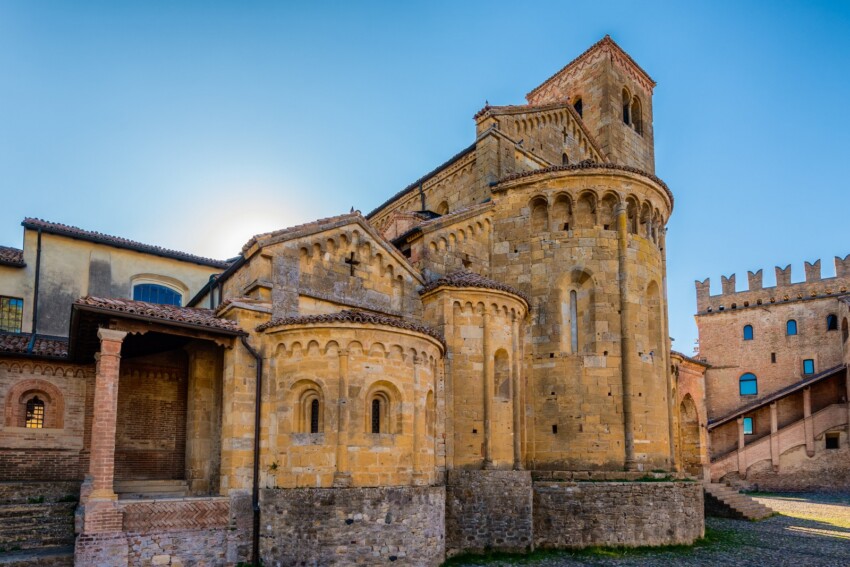
Another must-see is the Collegiata di Santa Maria Assunta, one of the village’s most important religious buildings, constructed in the 12th century on the site of an earlier church. Built in Romanesque style, the Collegiata underwent several alterations between the 18th and 19th centuries, most notably the construction of the bell tower that rises from the lower left nave.
The interior is adorned with frescoes and sculptures depicting biblical scenes and saints, including a notable cycle dedicated to Saint Catherine, dating from the 15th century. The oldest element, however, is the baptismal font carved from a single block of sandstone that may well have been used in the pre-existing church. Alongside the Collegiata stands a small museum housing important examples of religious art from the 13th to 15th centuries.
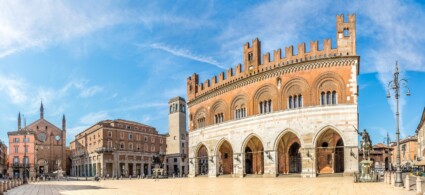
The Palazzo del Podestà was built as a residence in the late 1200s by Alberto Scotti, lord of Piacenza, and only in the 17th century was it converted into the seat of the Podestà and in the 19th century into the courthouse. Built in terracotta brick, with its change of use the building also underwent various alterations and additions.
On the exterior you can admire the Notaries’ Loggia, currently home to the tourist office, above which sits “the loggia of proclamations” from where municipal decrees were announced. Inside, in the great council chamber, you can admire a completely painted coffered ceiling and a splendid neogothic fresco cycle created in 1893 by Antonio Malchiodi.
Built in 1292 by Alberto Scotti as the seat of the courthouse, this building owes its name to the fact that in the early 17th century it became the residence of the Sforza family. Built in stone, it boasts a medieval-style façade and also features a relief depicting the coat of arms of the Brandolini family, who governed Castell’Arquato in the mid-15th century. In front of the palace stand the Fountains of the Duke with eight bronze spouts that were once used as a communal wash house by the village women.
Also known as the Torrione del Duca, the Torrione Farnese was commissioned between 1527 and 1535 on the orders of Bosio II of Santa Fiora, though it was the Sforza who continued the work, though it’s said never to have been fully completed. Built entirely in brick, the tower is an imposing square structure approximately 20 metres high that was designed as a defensive outpost. Inside it spans five storeys connected by a spiral staircase. Many legends are attached to this tower, including one that claims it was linked to the Palazzo del Duca via underground tunnels.
Housed in the 16th-century former Hospital of S. Spirito, the Cortesi Geological Museum is an ideal stop for geology and palaeontology enthusiasts. The museum holds a rich collection of fossils, minerals and geological specimens that tell the story of how the Val d’Arda and the Apennines were formed.
Not many people realise that in the Pliocene epoch this territory was entirely covered by the sea, and numerous fossil remains from that period have been discovered. Among the most important pieces in the collection are the skull of a whale shark discovered in 1983, molluscs and fossils of other marine animals that inhabited the area millions of years ago.
The best area to stay in Castell’Arquato is certainly the medieval heart of the village, where you’ll find welcoming bed and breakfasts and small hotels that offer an authentic experience. For those preferring to stay close to nature, the surrounding hills host agriturismos (farmstays) offering experiences immersed in the countryside.


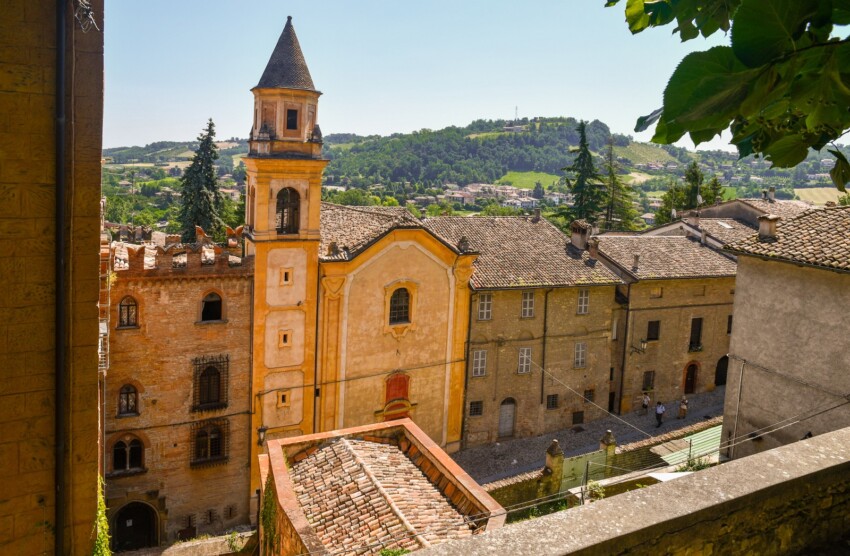
Castell’Arquato is easily accessible from various Italian cities by car, as its territory is served by the SP 4 Bardi road connecting Piacenza with Fiorenzuola d’Arda. From Bologna you can reach Castell’Arquato in one hour and forty minutes by travelling along the A1 towards Milan, exiting at Fiorenzuola and then following signs to Castell’Arquato along the SP4. From Rimini and Ravenna, you can take the A14 motorway to Bologna and then continue on the A1 towards Fiorenzuola d’Arda.
The closest railway station is at Fiorenzuola d’Arda, which lies on the Milan-Bologna railway line and is approximately 10 km from Castell’Arquato. The nearest airports to Castell’Arquato are Parma, 40 km away, and Milan Linate, less than 100 km away. The Guglielmo Marconi airport in Bologna is approximately 130 km away.
What's the weather at Castell’Arquato? Below are the temperatures and the weather forecast at Castell’Arquato for the next few days.
Castell'Arquato is a medieval village perched on a hillside in the Val d'Arda, located 10 km from Fiorenzuola d'Arda and 35 km from Piacenza.
 Hotel
Hotel  Budget accommodations
  Apartments
  Family Hotel
  Luxury Hotel
  Resorts