Relais SANT'AMBROGIO
Bobbio - località Sant'Ambrogio snc
Book now
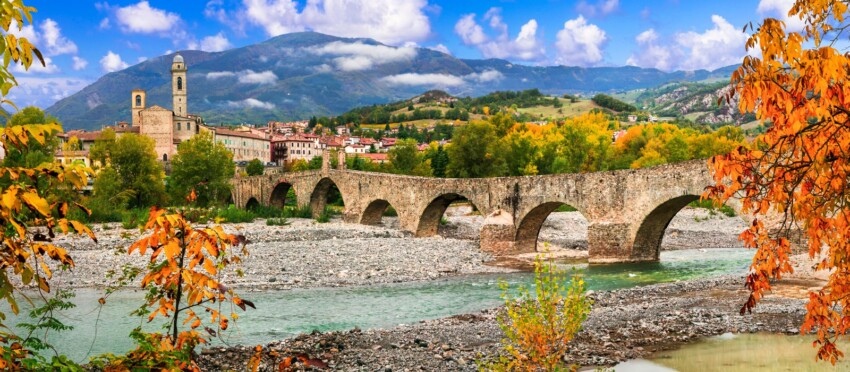
In the heart of the Val Trebbia, surrounded by pristine countryside, lies the medieval village of Bobbio, a place where history, culture and tradition interweave harmoniously, creating a unique and captivating atmosphere. This charming small town is one of the Apennines’ most precious gems and is renowned for being an important religious and cultural centre for centuries. Although archaeological evidence shows the territory was inhabited since ancient times, the most significant period in Bobbio’s history actually begins in the 7th century with the arrival of Saint Columbanus.
Columbanus was a monk of Irish origin who, after receiving the territory as a gift from Lombard king Agilulfo and queen Theodolinda, founded the Abbey of Saint Columbanus in 614. Saint Columbanus died a few years later, but the Abbey quickly became one of the principal religious and cultural centres of medieval Europe. Though Bobbio passed under various rulers including the Lombards, the Franks and the Duchy of Milan, the Abbey of Saint Columbanus managed to maintain its central importance. Here, thanks to the presence of monks, one of Europe’s most important scriptoriums developed – a centre where ancient manuscripts were copied and preserved before the invention of printing.
Furthermore, the Abbey’s library created an extensive collection of works that over the centuries attracted various scholars. Around the Abbey, a settlement quickly developed and Bobbio became a centre of great religious, cultural and economic importance. Despite the Abbey of Bobbio losing its prominence in more modern times, the village has continued to be a place of considerable charm that has managed to preserve much of its historical and cultural heritage.
Small, intimate and welcoming, Bobbio has managed to preserve over time monuments, churches and palaces that bear witness to its glorious past, whilst also serving as an ideal starting point for excursions into the splendid countryside of the Val Trebbia. Bobbio has not only been elected “Italy’s Most Beautiful Village” but has also been awarded the Orange Flag of the Touring Club Italiano.
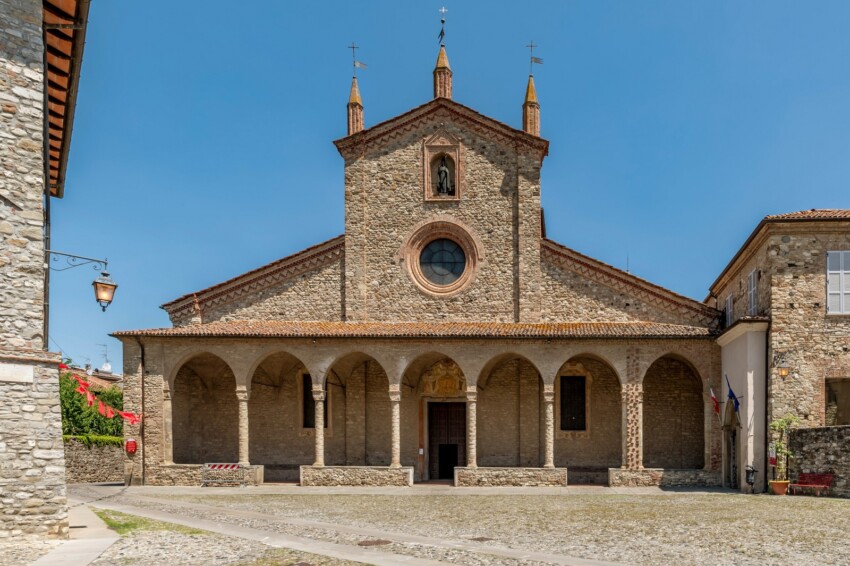
Founded by Saint Columbanus in 614, the Abbey of Saint Columbanus is the symbol of Bobbio and one of Italy’s most important monasteries, as from the Middle Ages onwards it was a centre of great religious and cultural influence. The abbey complex comprises the basilica, the cloister and other monastic buildings that are the result of expansion work carried out over the centuries. The Basilica, rebuilt in the 15th century on the remains of an old chapel, houses precious frescoes, works of art and a baptismal font offered to Saint Columbanus by queen Theodolinda.
Not to be missed is the crypt, which houses the saint’s remains and a beautiful collection of Early Christian mosaics, and the scriptorium, which was where monks dedicated themselves to the work of transcribing books before the invention of printing but is now used as the Abbey Museum. Finally, the 9th-century cloister, which once housed the monastery’s kitchens and refectory, has now been converted into the town museum, which tells the story of Saint Columbanus and more generally the history of this territory in the Middle Ages.
The Town Museum of Bobbio, housed in the section that once accommodated the Abbey’s refectory, is an essential destination for those wishing to explore the village’s history and culture, as it displays a rich collection of finds and artefacts. During the visit, you can follow a path that traces Bobbio’s history from antiquity to the present day through archaeological discoveries, manuscripts, paintings and objects of art.
In particular, a featured section tells the story of the bond between the Abbey and Bobbio with information about the life of Saint Columbanus, his arrival in Bobbio and the construction of the monastery. Another particularly interesting section houses the illuminated codices that bear witness to the monastery’s importance as a centre of culture and knowledge.
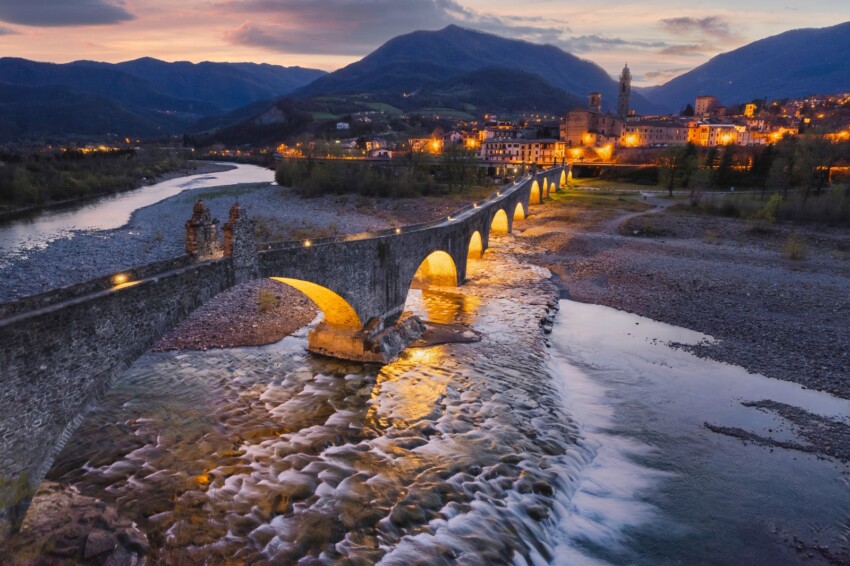
The Ponte Gobbo, also known as the Devil’s Bridge, is one of Bobbio’s most evocative monuments and certainly one of the most “Instagrammed” spots, as from there you enjoy spectacular views of the river and surrounding mountains. Legend has it that even Leonardo da Vinci was so impressed by the bridge that it appears painted in the background of the Mona Lisa in his famous work “La Gioconda”. Although some accounts report the presence of a bridge already in Roman times, the structure we can admire today was built in stone by the monks of the Abbey during the Lombard era.
This ancient bridge, 273 metres long, was built to cross the Trebbia river with eleven irregular arches that give it a unique appearance. Legend recounts that the monks of Saint Columbanus wanted to reach the town centre to spread the word of God, so they made a pact with the Devil, who in return could take the soul of the first monk to cross it. The bridge was built by the Devil in a single night, but the monks, rather than send one of their own to cross it, reportedly sent a dog instead. Today, the Ponte Gobbo can be crossed on foot or by bike and offers panoramic views of the surrounding hills, making it an ideal spot for photographs and moments of relaxation.
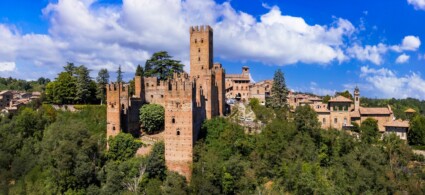
Another unmistakable symbol of the town is the Malaspina-Dal Verme Castle, which dominates the village of Bobbio from atop a hilltop and offers panoramic views of the town and valley. Built in the 14th century by the Malaspina family, the fortress is famous for being part of the Castles circuit of the Duchy of Parma, Piacenza and Pontremoli, and was later enlarged by the Dal Verme family, who transformed it into a mighty stronghold.
It is currently possible to visit the fortress, which hosts a museum trail through the internal rooms, some of which still feature period furnishings that tell the story of the castle and the various families that succeeded one another. You can also stroll through the internal courtyard and climb the towers to enjoy a panoramic view of the surrounding territory, particularly the beautiful Val Trebbia.
Bobbio’s Cathedral, dedicated to Santa Maria Assunta, was built in the 10th century but underwent several alterations over time with the addition of Romanesque, Gothic and Baroque elements. The interior of the cathedral features a Latin cross plan with three naves and perimeter chapels, covered by cross vaults.
Inside are many works of art including frescoes, sculptures and finely decorated altars; in particular, the Cupola of San Giovanni houses a 15th-century fresco of the Annunciation, while the transept cupola features an 18th-century fresco. In the Cathedral’s crypt, meanwhile, lie many of Bobbio’s most important bishops from the 17th century onwards.
Another beautiful medieval complex in Bobbio is the Convent of San Francesco, built in the 13th century, which has managed to preserve part of its original structure. It is said that Saint Francis of Assisi spent time here in meditation and prayer. Within the complex is the Church dedicated to San Francesco and the monastery, the former having undergone various modifications over the centuries.
In the 19th century, with the arrival of the Napoleonic army, the Franciscan monks were expelled and the church converted into a warehouse. The monastic complex spans two floors with a large square bell tower at its centre and two beautiful cloisters dating from the 15th century.
In the following map you can see the location of the main places of interest mentioned in this article.
Bobbio is a village that has managed to preserve its medieval layout, so the best area to stay is undoubtedly the historic centre, where you will find various accommodation options. The centre is the ideal place to stay for those who wish to immerse themselves in the village’s atmosphere and have all the main tourist attractions, restaurants and shops within easy reach.
For those seeking a more peaceful stay surrounded by nature, the Val Trebbia around Bobbio offers numerous accommodation solutions for those who love outdoor living and wish to taste local specialities or take part in activities such as hiking or horse riding.
Given its strategic location, Bobbio has always been a true crossroads and is now reachable in about two hours’ travel from the larger cities of the north. For those travelling by car, Bobbio is reached via the motorway network, particularly the A1 (Milan-Naples), which you can travel until the Piacenza Sud exit, then continue along the SS45 Val Trebbia following the signs for Bobbio. From Genoa, meanwhile, Bobbio can be reached in about an hour and a half, following the SS45. From Turin, you need to travel along the E70 until the Piacenza Ovest toll booth and then take the SP9 and SS461 towards Genoa.
For those who prefer to travel by train, the nearest railway station to Bobbio is Piacenza, located about 45 km from the village. From Piacenza station, you can reach Bobbio via one of the direct buses that travel the scenic Val Trebbia road.
For those arriving by plane, the nearest airports to Bobbio are Milan Linate Airport, about 110 km away, and Parma Airport, about 120 km away. From each of these airports, you can hire a car and reach Bobbio, or take a train to Piacenza and then continue by bus to Bobbio.
What's the weather at Bobbio? Below are the temperatures and the weather forecast at Bobbio for the next few days.
Bobbio is a small municipality in the province of Piacenza, nestled on the slopes of the Apennines, not far from the territories of Lombardy, Liguria and Piedmont. The town is excellently positioned some 50 km from Piacenza, 108 km from Parma and 135 km from Reggio nell'Emilia.
 Hotel
Hotel  Budget accommodations
  Apartments
  Family Hotel
  Luxury Hotel
  Resorts