Le Querce Hotel
Salsomaggiore Terme - Via Parma 85
Book now
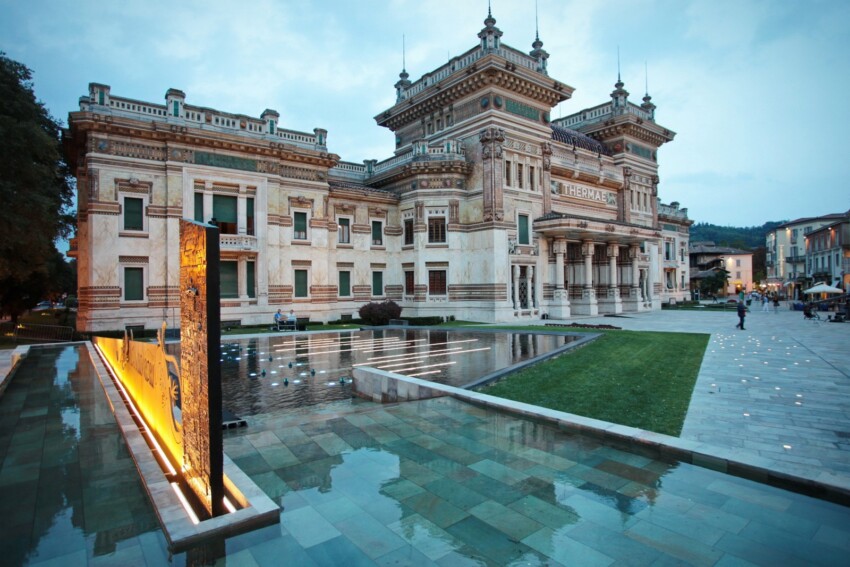
Renowned since ancient times for its thermal waters, Salsomaggiore Terme is a spa town nestled in the heart of Emilia-Romagna, surrounded by rolling green hills and vineyards. An ideal destination for those seeking relaxation, wellness and culture, Salsomaggiore Terme also boasts a rich historical and artistic heritage that testifies to its thousand-year history. The town’s roots stretch back to pre-Roman times, when the Celtic populations of the area discovered the healing properties of its saline waters.
It was only during the Roman era that the town began to gain fame for its waters, exploited for curative and ritual purposes. Furthermore, the ancient Romans not only used the saline springs for physical wellbeing but also for salt production, considered a precious resource at the time. In the Middle Ages, Salsomaggiore became an important salt production centre, known as “white gold”, and was consequently contested between various noble families and the papacy. During the Renaissance, the town continued to thrive thanks to salt production and the earliest rudimentary forms of thermal tourism aimed at the local aristocracy.
Salsomaggiore’s rise as an internationally renowned spa centre began only in the 19th century, with the construction of the first thermal facilities following the discovery of the healing properties of its waters. Renowned architects and artists, such as engineer Giulio Bernardini and architect Ugo Giusti, contributed to the creation of extraordinary buildings that combine Liberty and Art Deco elements, making Salsomaggiore one of Europe’s most important spa destinations. Over the years, Salsomaggiore Terme also became famous for hosting several editions of the renowned Miss Italia competition.
The town centre is a fascinating blend of Liberty and Art Deco architecture, a legacy of the golden age of thermal tourism between the 19th and 20th centuries. The streets are lined with historic buildings, lush parks and elegant boutiques that create a relaxed and refined atmosphere. All around the historic centre are green spaces and hills that often host ancient castles or fortresses built to protect the numerous salt wells in the area.
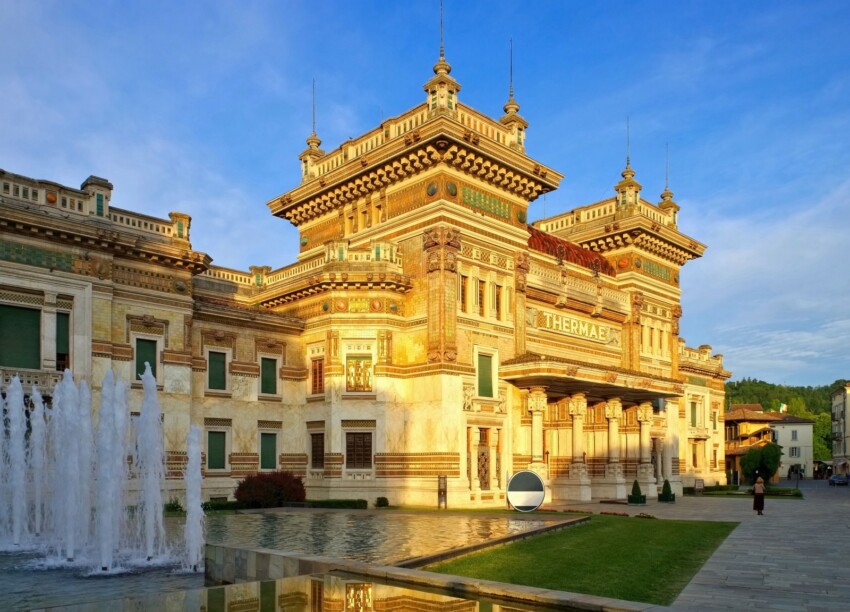
The undisputed symbol of Salsomaggiore Terme is undoubtedly the Palazzo delle Terme Berzieri, a building inaugurated in 1923 that is considered one of the finest examples of Art Deco in Italy. Designed by architects Ugo Giusti and Giulio Bernardini, with interior decorations by Galileo Chini, the Terme Berzieri are a combination of Liberty style, Art Deco and Oriental influences.
The palace is a true architectural jewel and deserves a visit not only for its thermal activities but also for its incredible beauty and decorative richness. Inside, beyond the treatments, you can admire splendid frescoes, mosaics and sculptures that create an atmosphere of unique refinement.
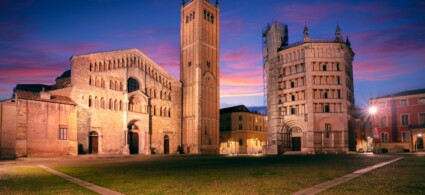
In the heart of Salsomaggiore Terme stands the Duomo di San Vitale, a perfect example of a religious building with futuristic forms. First built around the 12th century in Gothic style with a Latin cross layout, the Cathedral was demolished and rebuilt several times. The complex we can admire today is the result of work carried out in the 20th century by architect Giulio Ulisse Arata, who created a truly distinctive project.
The church, positioned on an elevated site, features a central Greek cross plan and was built above a crypt, also known as the Sanctuary of the Blessed Virgin of Grace. The crypt, meanwhile, has a Latin cross layout and independent access.
Not far from Terme Berzieri stands the Palazzina Warowland, a Neo-Lombard medieval-style building designed by Orsino Bongi in 1912 on commission from Count Ladislao Tyszkiewicz. Tyszkiewicz housed his ancient art collection here for many years before the building was expropriated by the State. The interiors have retained Neo-Gothic elements, heraldic emblems and fine furnishings. Today, the building houses the Tourist Information Office and the Tourism Department.
Right next to Terme Berzieri lies Parco Mazzini, a green oasis in the heart of the town designed in 1924 and an ideal spot for a relaxing stroll or to enjoy some peace in the shade of majestic trees. The park hosts several rare botanical species and offers an enchanting setting with small lakes, fountains and pathways winding through flowerbeds. It’s the perfect place for a rejuvenating break, perhaps after a spa session, or simply to immerse yourself in nature.
A few kilometres from Salsomaggiore Terme, on a hill overlooking the Stirone Valley, stands the Castello di Tabiano, one of the best-preserved fortresses in the area. Built in the 10th century, the complex, despite various alterations, has maintained its original medieval structure intact. In recent years the fortress and the medieval village of Tabiano have been converted into a distributed hotel and can be visited via guided tours. During your visit, you can explore frescoed rooms, ancient kitchens, dungeons and towers that tell centuries of history and legends.
The healing properties of Salsomaggiore’s waters were officially discovered only in 1839 by physician Lorenzo Berzieri, although they had been exploited since ancient Roman times. His studies on the benefits of thermal waters were subsequently continued by other doctors, many of whom also chose to open their homes for the treatment of patients. Only in the mid-19th century was a first rudimentary thermal facility established to welcome wealthy noble patients.
Over time, the benefits of the saline-bromine-iodine thermal baths became increasingly understood and Salsomaggiore rapidly developed as a premier thermal destination. Now the main centres are located in Salsomaggiore Terme and Tabiano, where some of Europe’s finest sulphurous waters are used as allies for health and wellbeing.
Salsomaggiore Terme offers a wide range of accommodation options, from elegant thermal hotels to charming bed & breakfasts located in the surrounding countryside. The central area of the town is ideal for those who wish to be close to the main attractions, such as Terme Berzieri and Parco Mazzini. Here you will find several luxury hotels offering thermal and wellness packages, perfect for a relaxing stay.
For those seeking a quieter experience in touch with nature, the countryside around Salsomaggiore offers farmhouses and historic residences that allow you to immerse yourself in the beauty of the Emilian landscape. These accommodations often feature local produce and outdoor activities, such as hiking and cycling excursions, ideal for exploring the area.


Salsomaggiore Terme is well connected to Italy’s major cities and is easy to reach by car or train. Those travelling by car from the north can take the A1 motorway to the Fidenza-Salsomaggiore exit and then follow the signs for Salsomaggiore Terme; from the south, you can take the A15 (Parma – La Spezia) to the Parma Ovest exit and then follow the signs for Salsomaggiore. Salsomaggiore is located approximately 40 minutes’ drive from Parma and just over an hour from Bologna. The railway station in Salsomaggiore Terme has frequent regional trains to major cities such as Parma and Piacenza. The nearest airports to Salsomaggiore Terme are Parma Airport (approximately 40 km away) and Bologna Guglielmo Marconi Airport (approximately 120 km away).
What's the weather at Salsomaggiore Terme? Below are the temperatures and the weather forecast at Salsomaggiore Terme for the next few days.
In Parma province, nestled among the lush hills of the Apennines, lies the town of Salsomaggiore Terme, renowned for years for its thermal spa centres. The town enjoys a strategic location, with easy access to several important Italian cities: Parma is just 35 km away, Piacenza 50 km, and Reggio Emilia 70 km distant.
 Hotel
Hotel  Budget accommodations
  Apartments
  Family Hotel
 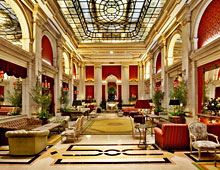 Luxury Hotel
 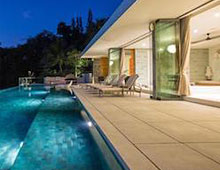 Resorts