LOCANDA LA CAMPAGNOLA orari check in dalle 1130 alle 1530 e dalle 1800 alle 2300
Vignola - 12 Via Cà de Barozzi
Book now
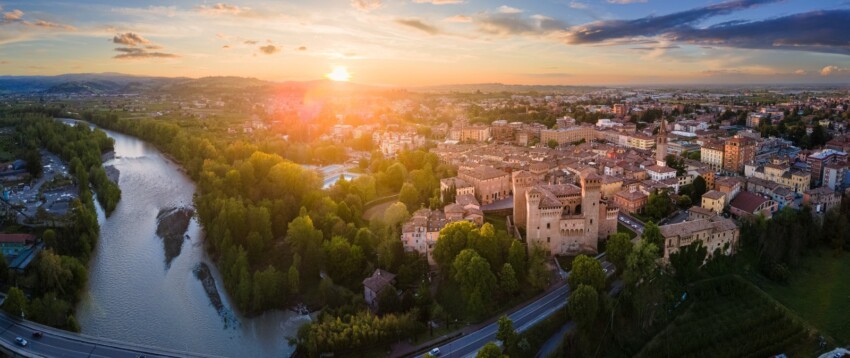
Situated in the heart of Emilia-Romagna, Vignola is a charming town brimming with history, nature and culinary traditions, making it the perfect destination for a trip centred on culture, relaxation and excellent food. This centre, nestled amongst the rolling hills of the Modena province, is renowned for its picturesque landscape, well-preserved historical monuments and its outstanding cherries, which are celebrated not only throughout Italy but also internationally. This territory has been inhabited since ancient times, with evidence dating back to the Bronze Age, though Vignola’s true history has its roots in the Roman era. During that period, the territory was inhabited by communities devoted to viticulture, which is why the name “Vignola” is believed to derive from the Latin “vineola”, meaning “small vineyard“.
During the Middle Ages, Vignola became an important agricultural and commercial centre thanks to its strategic location along the main communication routes between Modena and Bologna. Over the centuries, the town witnessed the succession of various rulers, most notably the Lombards, the Franks and, finally, the House of Este, who left an indelible mark on the city. It was under Este rule that the famous Rocca di Vignola was built, one of the city’s most important symbols and a testament to its medieval past. As in other Italian towns, the Renaissance brought a period of cultural and artistic flourishing to Vignola, marked by the construction of numerous noble palaces and churches of great value.
Today, the city continues to preserve its historical charm and offers a rich heritage of architecture, art and traditions that captivate all visitors. Added to this is the fact that agriculture has played and continues to play a central role in Vignola’s economy, particularly in the production of the Mora di Vignola cherry, a protected geographical indication product.
Vignola is a town that developed in stages, initially as an urban settlement that grew up around the Rocca, which was surrounded by defensive walls and became known as Castelvecchio. In the 15th century, the town needed to expand, leading to the creation of a new wall circuit punctuated by defensive towers that enclosed the so-called Castelnuovo.
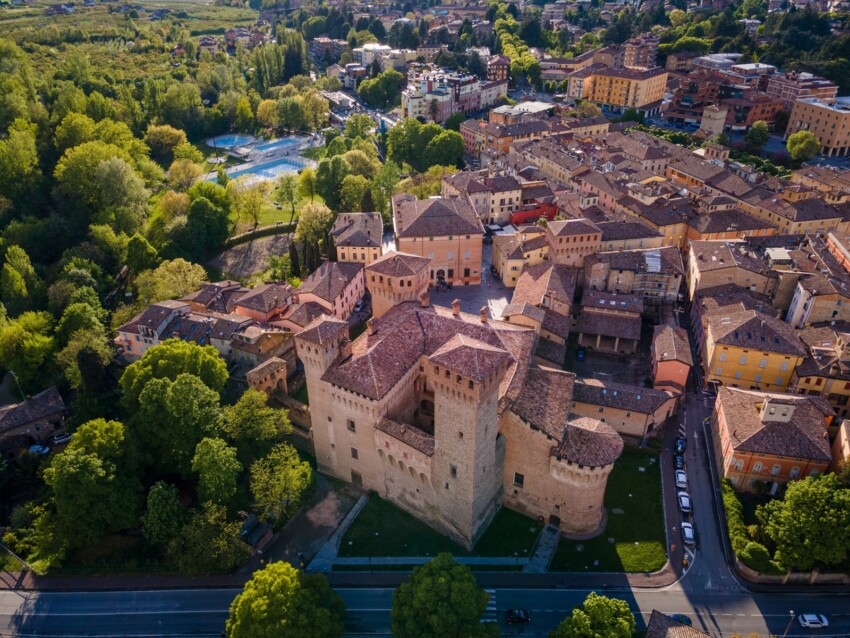
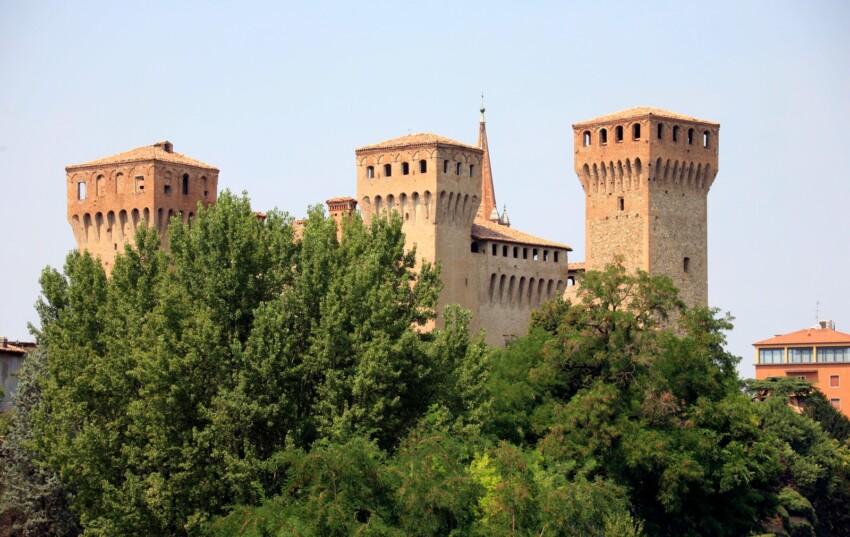
The Rocca di Vignola was constructed in the 8th century at the behest of the abbot of Nonantola, then expanded and fortified over the centuries until it was transformed in the 15th century into a residence for the Contrari family, who were close allies and beneficiaries of the Este dynasty. It is considered the city’s main attraction, being one of the finest examples of medieval military architecture. The Rocca comprises a main quadrangular structure protected by three imposing towers and a moat.
The beautifully decorated interiors can be admired thanks to restoration work, offering a fascinating glimpse into medieval life and culture; among the most captivating areas is the Cappella dei Contrari, which houses splendid frescoes depicting scenes from the life of Christ. It is advisable to walk along the ramparts surrounding the fortress and to climb to the top of the towers to enjoy panoramic views over the city and surrounding countryside.
Vignola was the birthplace of important figures such as the architect Jacopo Barozzi, known simply as Vignola, who created significant works throughout Emilia-Romagna. Among his many structures stands Palazzo Contrari – Boncompagni, also known as Palazzo Barozzi, located right beside the Rocca.
Built in the 16th century by “Vignola” for Ercole Contrari, this Renaissance palace is famous for its spiral staircase, considered one of Italy’s finest, designed with unique mathematical precision and architectural elegance. Helical in form and comprising 106 steps, the staircase is regarded as a masterpiece of Renaissance engineering both for its structure and its decorative elements.
The Church of Saints Nazario and Celso is another must-see attraction in Vignola, notable for its architectural and artistic beauty. Constructed in the 13th century and subsequently enlarged, this church is renowned for its campanile in Romanesque style and the frescoes and decorations that adorn its interior walls. Externally, the church features a simple façade with pitched roofs, whilst inside, along its three naves, visitors can admire sacred artworks and wooden sculptures of considerable artistic value. Among the most fascinating creations are a bronze Pietà by Ivo Soli, 17th-century paintings by Elisabetta Sirani, Simone Cantarini and Francesco Stringa, and a Martyrdom of Saints Nazario and Celso by 19th-century painter Adeodato Malatesta.
For nature lovers, the Parco Regionale dei Sassi di Roccamalatina is an unmissable stop, located in the Modena Apennines a short distance from Vignola. This park offers breathtaking scenery with its unique rock formations, hiking trails immersed in pristine nature and rich biodiversity.
Extending over two thousand hectares, the park is the ideal destination for hiking by bike or on horseback, walking or outdoor picnicking, as well as observing a rich heritage of flora and fauna. Within its boundaries, more than 80 bird species nest and over 40 mammal species can be found, including wolves, roe deer, fallow deer, badgers, foxes, pine martens and porcupines.
The historic centre of Vignola is the best choice for those wishing to be close to the main tourist attractions and enjoy the city’s vibrant atmosphere, as there are several accommodation options offering comfortable rooms and modern facilities.
For those preferring a more peaceful stay, the areas surrounding Vignola offer a wide range of farm stays and holiday homes nestled in the countryside, where you can relax, enjoy splendid panoramic views and sample excellent local produce.
Vignola is easily accessible from major Italian cities thanks to its strategic location in the heart of Emilia-Romagna and its proximity to Modena. From Modena, Vignola can be reached by car in approximately 30 minutes via the SS 623 (formerly SS 623 del Passo Brasa). From the north, Vignola is reached via the A1 motorway until the Modena Sud exit, then continuing on the SS 623. For those coming from Bologna, it is possible to travel along the SP 569 and reach Vignola in less than 45 minutes.
Vignola also has a railway station located just a few steps from the historic centre and connected to Bologna and Modena via regional rail lines. There are also several bus services linking Vignola to Modena, Bologna and other nearby towns, offering a valid alternative for those preferring not to drive. Finally, the nearest airport is Bologna’s Guglielmo Marconi airport, situated approximately 30 km away.
What's the weather at Vignola? Below are the temperatures and the weather forecast at Vignola for the next few days.
Vignola sits in Modena province at the foot of the first hills of the Modena Apennines. The town lies 25 km from Modena, 50 km from Reggio Emilia and 130 km from Piacenza.
 Hotel
Hotel  Budget accommodations
  Apartments
  Family Hotel
  Luxury Hotel
  Resorts