Orderly, elegant and perfectly suited to the human scale, Modena is particularly renowned for its Piazza Grande, declared a UNESCO World Heritage Site, its Protected Designation of Origin balsamic vinegar and the Enzo Ferrari Museum.
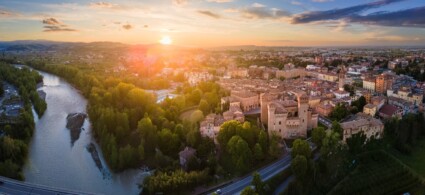
Renowned worldwide for its traditional balsamic vinegar and as the home of Ferrari, Modena is a charming town nestled in the heart of Emilia-Romagna that captivates with its rich historical, cultural and gastronomic heritage. Modena boasts an ancient history, with its territory first inhabited by the Etruscans and then by the Romans, who called it “Mutina”. During the Roman period, Modena became an important military stronghold and later a significant trading hub.
During the Middle Ages, the city became territory of the Este family, who in 1598 relocated the capital of their duchy from Ferrara to Modena. This decision brought about a period of significant cultural, artistic and architectural development, though many artworks created during this era were later looted during the Napoleonic spoliations. Duke Francesco III d’Este was also responsible for founding the Military Academy to train officers of the Este army, which following Italian unification became the first military school of the Sabaudi Kingdom under Vittorio Emanuele II and in 1947 became the Military Academy of the Army and the Carabinieri Corps.
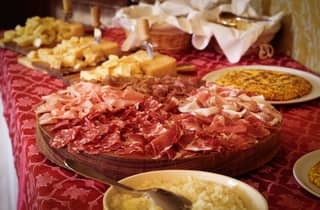
Today Modena presents itself as an orderly, well-maintained and human-scaled town with numerous sites of interest to discover, attractions to visit and a long gastronomic tradition. As mentioned earlier, balsamic vinegar has been produced in Modena for centuries using techniques passed down through generations, but this is also the land of products such as Parmigiano and Lambrusco wine. Furthermore, this is the birthplace of renowned tenor Luciano Pavarotti (1935–2007), and over the years the city has developed a rich musical heritage as a result. Another distinctive feature of Modena is that it is known as a land of motors, as Ferrari, Maserati, Ducati and Lamborghini were all born here in small workshops before becoming symbols of Italian excellence worldwide.
Things to do in Modena
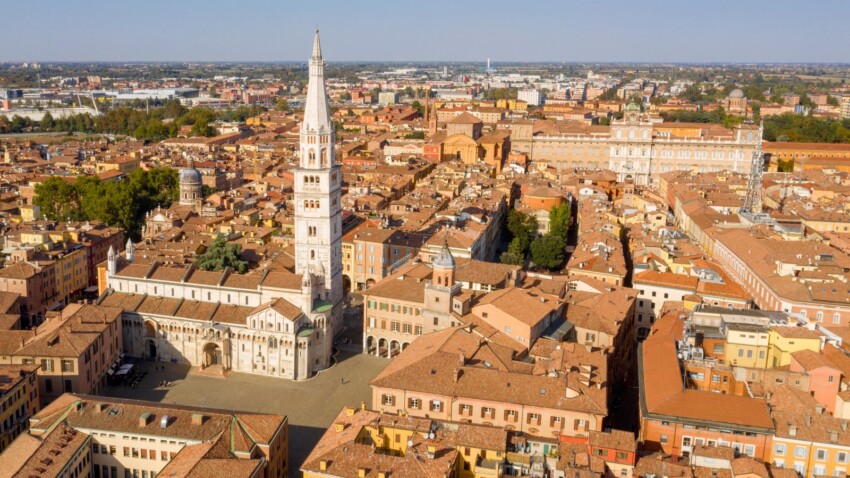
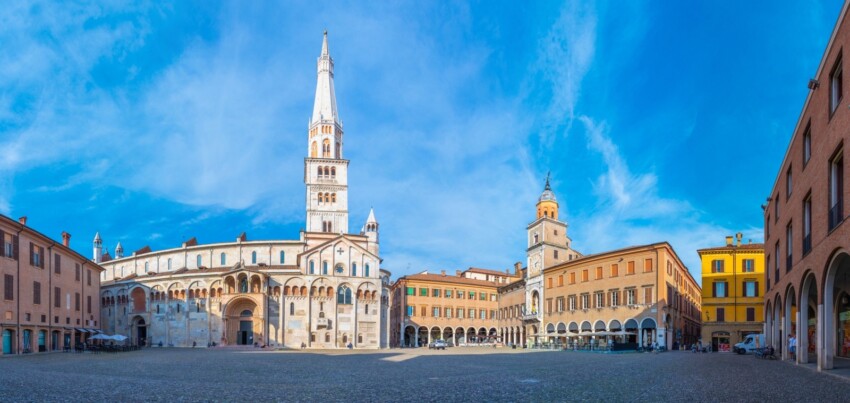
Modena is often overlooked in itineraries exploring our peninsula, yet the city is a true gem waiting to be discovered as you wander through its cobbled streets. Its historic centre is anchored by Piazza Grande, which together with the Cathedral and Civic Tower have been inscribed on the UNESCO World Heritage list since 1997.
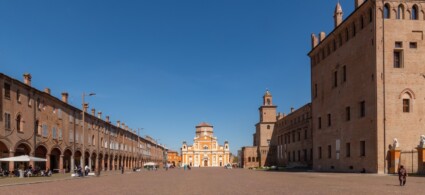
At the pulsing heart of Modena lies Piazza Grande, a medieval square surrounded by historic buildings including the Town Hall, Modena Cathedral with its Ghirlandina tower and the Archbishop’s Palace. It is here that the city’s main events take place, such as markets, performances and local celebrations, as well as protests and public rallies.
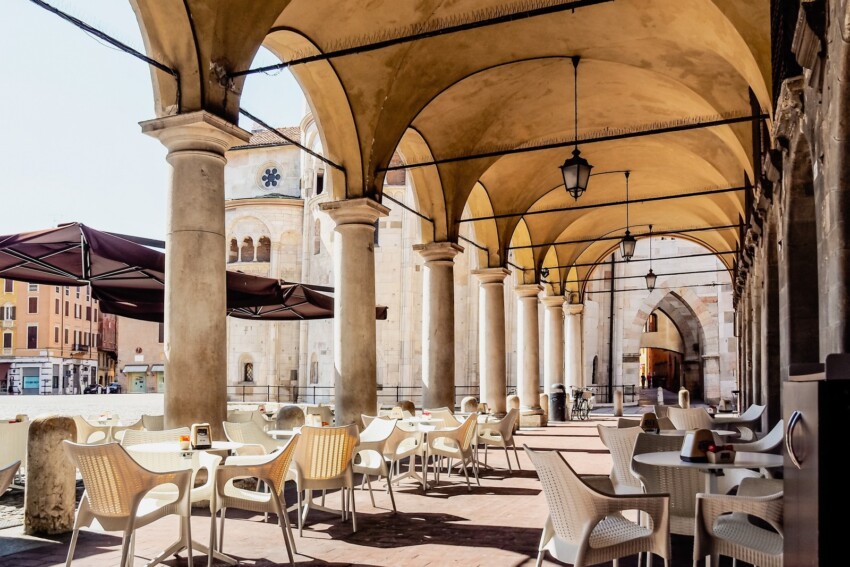
A stroll through the square and along its arcades offers the perfect opportunity to fully absorb the vibrant atmosphere and immerse yourself in the city’s daily life. On the eastern side of the square stands the Town Hall, a 17th-century building constructed by combining two ancient medieval palaces of the Council and the Hall of Justice, while on the southern side is a palace of a financial institution designed by architect Gio Ponti.
Near the entrance to the Town Hall you can observe the “Prera Ringadora“, or the “ringing stone”, so named because it was used by politicians addressing citizens for centuries; however, it appears that for a period it was also called the “stone of dishonour” as it was reserved for the public display of Modenese citizens unable to repay their debts.
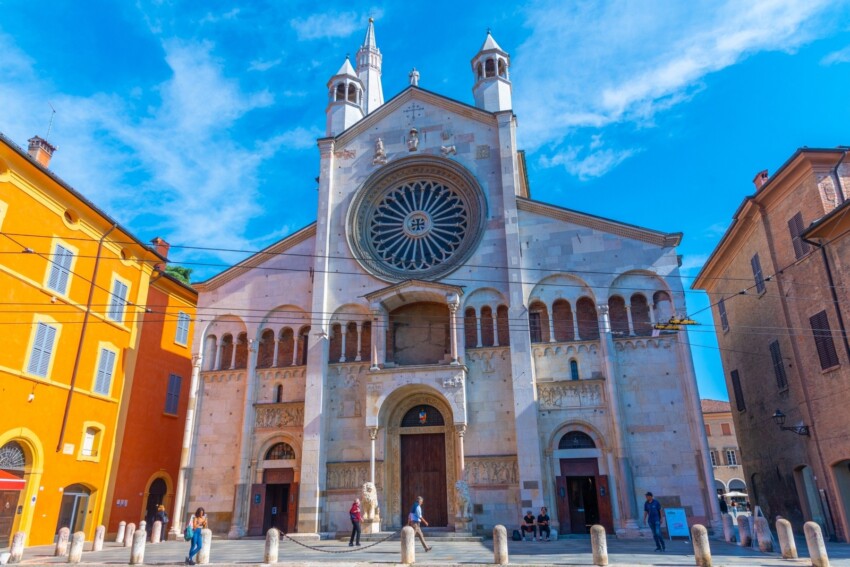
Considered one of Europe’s masterpieces of Romanesque art, Modena Cathedral was designed by architect Lanfranco in 1099 and constructed on the site that once housed the sepulchre of San Geminiano, Modena’s patron saint. Externally, the façade is decorated with sculptures by Wiligelmo and features a grand rose window created in the 13th century, whilst beside it stands the bell tower, known as the Ghirlandina.
**Inside, the church boasts three naves with cross vaults completed only in the 16th century and, in the raised presbytery, a grand and worthy high altar. The most important area, however, is the crypt, which is finely decorated and houses the relics of San Geminiano preserved in a simple 4th-century urn. Each year on the saint’s feast day, which falls on 31 January, the sarcophagus is opened and his remains are presented for the veneration of the faithful.
Next to the Cathedral stands the Ghirlandina Tower, which at 86 metres tall and with its historical significance is considered the symbol of the city. It is truly worth climbing to the top of the tower as its panoramic terrace offers magnificent views of the city and the surrounding countryside.
Construction of an original tower at this location dates back to 1130, but it has undergone numerous alterations and renovations until reaching its current form in the late 19th century. In 1897, after installing a large metal framework around the entire tower, it was clad in Verona marble.
The Ghirlandina Tower was used to safeguard important public documents, valuables and strongboxes, whilst the bells from the outset not only marked the hours for the city but were also used to warn the population of potential dangers or invasions.
The Town Hall of Modena as we see it today is the result of works carried out between the 17th and 18th centuries that unified several existing buildings to create this complex. Around the mid-17th century, the civic tower was added here, though it is also known as the “truncated tower” because in 1671 a section collapsed following an earthquake.
Inside the Palace are finely decorated rooms and chambers containing objects of historical importance to the city, such as the “Stolen Bucket“, a wooden pail that for the people of Modena is a symbol of their victory against Bologna in 1325. According to ancient tradition, after winning the Battle of Zappolino, the Modenese took this bucket from a Bolognese well and brought it to the city as a trophy.
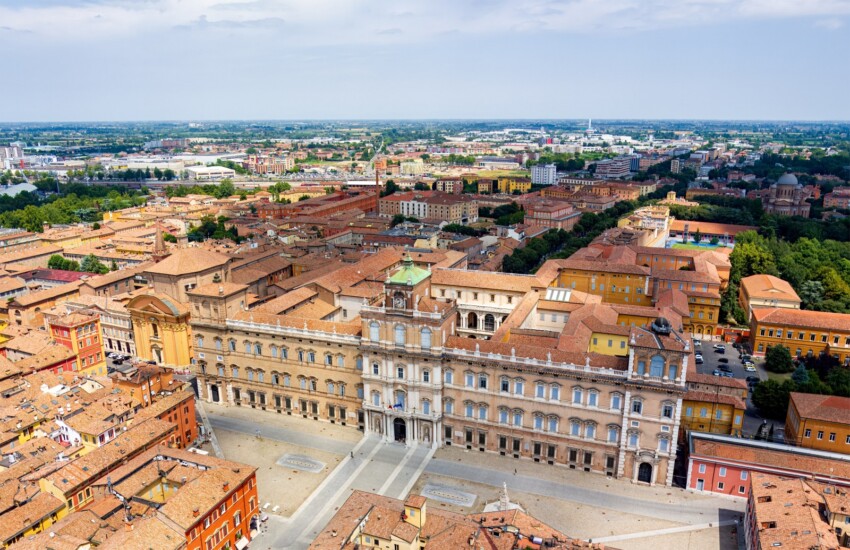
A must-visit for anyone exploring Modena is undoubtedly Palazzo Ducale, another fine example of Baroque architecture in the city, though it is only open to the public with guided tours that must be booked in advance. Its construction began in 1634 under Duke Francesco I d’Este, who desired a residence befitting the Este court and chose to build the palace on the site of a pre-existing small fortress.
Several internationally renowned artists worked on the project, including Gian Lorenzo Bernini, Francesco Borromini and Pietro da Cortona, who contributed to creating a Baroque palace with elegant and refined interiors. Following Italian unification, the Palace became home to the prestigious Military Academy of Modena, which has counted illustrious students whose names are remembered in the Gallery of Memory housed in the Academy’s Museum Hall.
Estense Gallery
6Palazzo dei Musei Sala Mostre: piano terra | Galleria Estense: quarto piano, Largo Porta Sant'Agostino, 337, 41121 Modena MO, Italy
The Estense Gallery is a museum complex with locations in three Italian cities—Sassuolo, Ferrara and Modena—where it is housed in the Palace of Museums. In Modena, the Gallery displays works that were once owned by the Este family as well as artworks, marble and terracotta statues and other artefacts.
The Gallery features four grand halls and several exhibition areas that showcase not only the rich artistic heritage collected by the Este dukes between the 14th and 18th centuries but also works acquired later. Among its most renowned pieces are: Cima da Conegliano’s Pietà, Velázquez’s Portrait of Francesco I d’Este, Correggio’s Madonna and Child, Bernini’s marble bust of Francesco I d’Este and Guido Reni’s Crucifix.
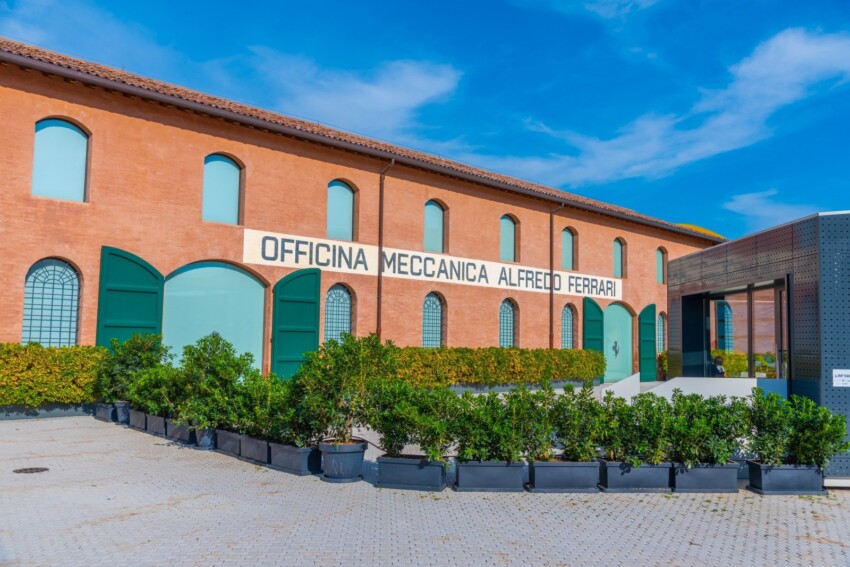
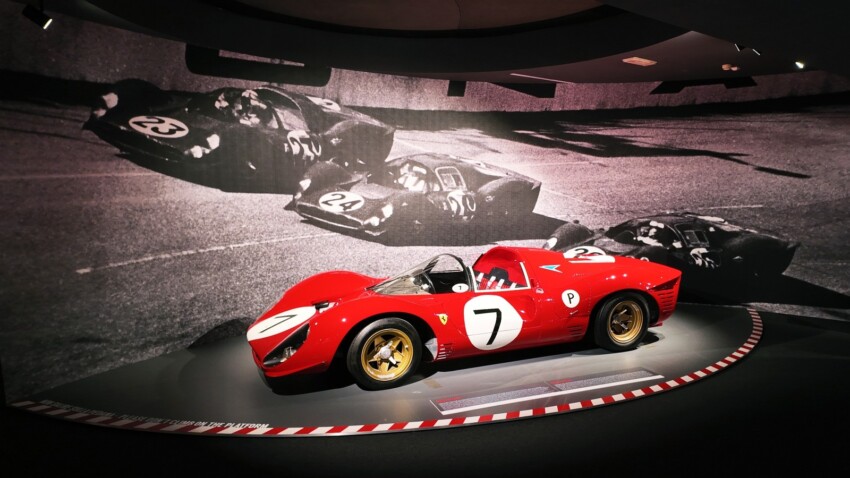
Car enthusiasts cannot miss the Enzo Ferrari House Museum, which not only celebrates the life of the founder of the legendary car manufacturer but also displays an extensive collection of historic and contemporary automobiles. Inaugurated in 2012, the museum is housed in Enzo Ferrari’s birthplace, where both Enzo and his father Alfredo before him operated a workshop.
In the building that once housed the workshop adjacent to the residence, numerous Ferrari models are now displayed alongside vehicles from other marques that have shaped motoring history. In the residence itself, visitors can discover the history of the Ferrari family, their passion for engines and, through documents and photographs, trace the history of the Ferrari brand.
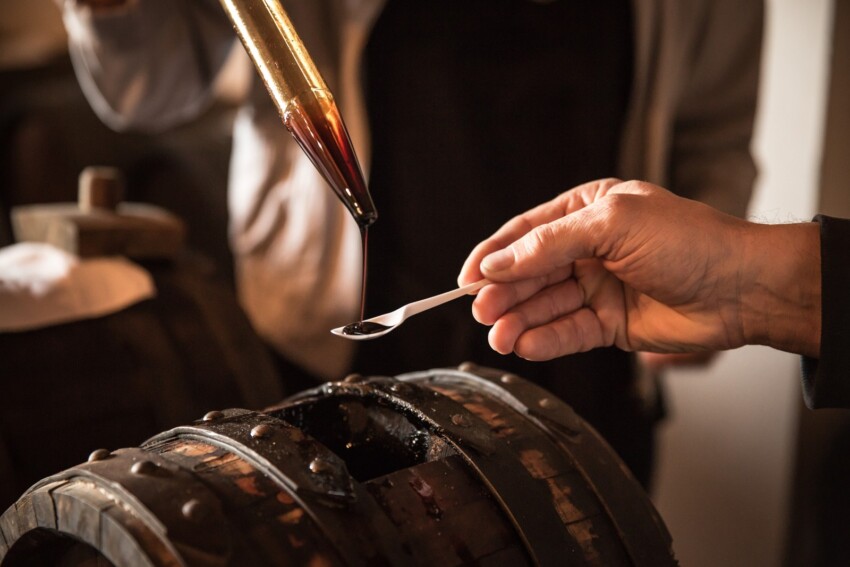
To better understand Modenese culture and traditions, a visit to the Municipal Balsamic Vinegar Factory explains the production process of Modena’s balsamic vinegar. Balsamic vinegar was highly prized by the Este court from early on and at the time was considered a precious, quality product reserved only for special occasions. The acetaia (vinegar factory) is located in the attic of the Town Hall and houses three batteries of barrels—two small and one large—containing precious traditional balsamic vinegar, alongside various panels explaining its production.
The Municipal Balsamic Vinegar Factory can only be visited through daily guided tours that allow you to discover the origins and history of this typical product as well as taste some of its variants. Outside the historic centre, there are several private vinegar factories that organise tours and tastings to explore this product further.
The Luciano Pavarotti House Museum, situated in the hills surrounding Modena, is the final residence of the celebrated tenor, opened to the public in 2015. This villa, designed by Pavarotti himself, preserves intact the living spaces with his personal belongings, stage costumes, family photographs and the Maestro’s awards.
Throughout the rooms you can still feel the passion of the great artist for music, painting and cooking. Visitors can immerse themselves in Pavarotti’s daily life, from his beloved kitchen where he enjoyed cooking for friends to the studio where he practised.
Ferrari Museum in Maranello
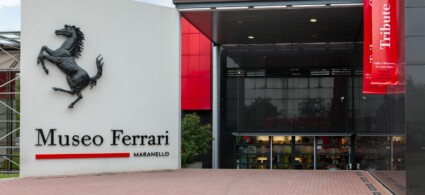
Just outside Modena, the Ferrari Museum in Maranello represents a temple to Italian automotive excellence, a place where past and future merge in the legend of the Prancing Horse. Inaugurated in 1990, the museum showcases the most iconic cars in Ferrari’s history, from the earliest racing models to modern supercar road versions.
Thematic galleries chronicle the technological evolution, Formula 1 triumphs and innovations that have made the brand a global symbol. An immersive experience enriched by driving simulators and interactive installations celebrating the Ferrari myth.
In the following map you can see the location of the main places of interest mentioned in this article.
Where to stay in Modena
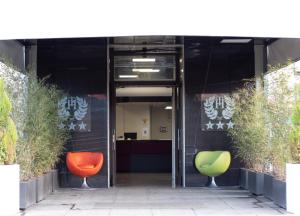
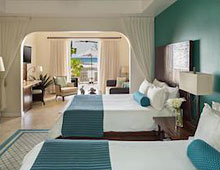
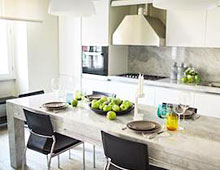
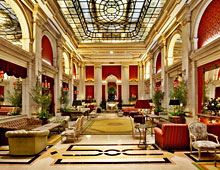
Modena offers a wide range of accommodation options to suit the needs of every traveller, from four-star hotels to charming bed & breakfasts, alongside apartments and a few hostels. The best area to stay is undoubtedly the historic centre, where you can easily reach the main attractions on foot as well as many restaurants and shops.
We offer best rates If you find it cheaper we refund the price difference.
Free cancellation Most properties allow cancellation without penalty.
We're available 24 hours a day For any problem call Booking.com.
Modena is easily accessible both by car and public transport, thanks to its central and strategic location. The city has excellent connections to Italy’s main motorways, and the A22 Brenner motorway actually departs from Modena, providing links to other European countries. Bologna is approximately 55 km away and can be reached via the E45, whilst Parma is 60 km away and accessible via the A1.
Those preferring to travel by train can use Modena’s railway station, which is served by regional and national trains and is considered an important hub on the Italian rail network. Modena is conveniently reached by train from cities such as Bologna, Verona, Milan and Florence. The nearest airport is Bologna’s “Guglielmo Marconi” Airport, located approximately 40 km away and well connected to Modena’s city centre by bus services.
Modena Weather
What's the weather at Modena? Below are the temperatures and the weather forecast at Modena for the next few days.
Sunday 18
14°
22°
Monday 19
13°
23°
Tuesday 20
12°
21°
Wednesday 21
15°
21°
Thursday 22
12°
20°
Friday 23
11°
17°
Where is located Modena
Modena sits at the heart of Emilia-Romagna, in a strategically positioned location that's easily accessible from Italy's major cities. The city lies roughly 60 km from Bologna, 140 km from Ravenna and 160 km from Rimini.


 Hotel
Hotel 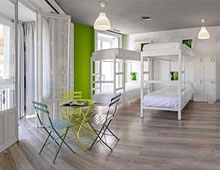 Budget accommodations
  Apartments
  Family Hotel
  Luxury Hotel
  Resorts