Hotel Lory
Forlì - Via Giovita Lazzarini 20
Book now
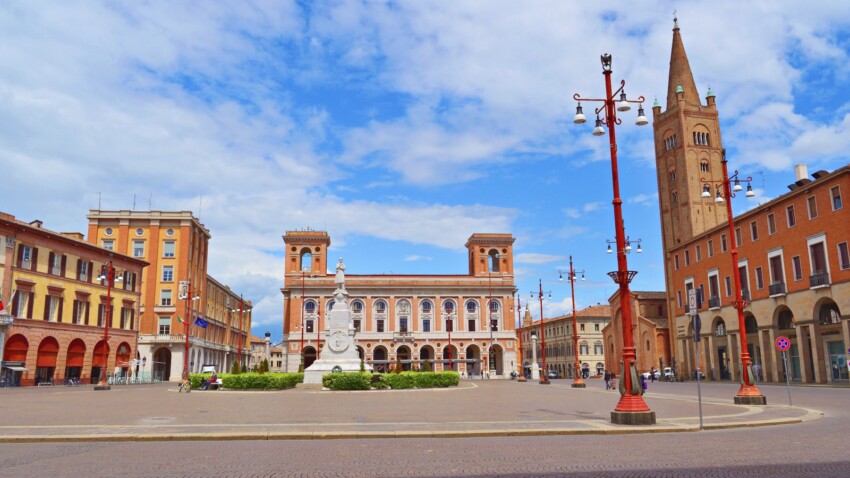
Also known as the “Cittadone” (Zitadon in the local dialect) for its large population, Forlì is a city rich in art, culture and traditions, perfect for discovering on foot during a weekend break. The city is now renowned for its long history, interesting museums and culinary traditions that appeal to all palates. It is confirmed that this territory was inhabited as far back as the Palaeolithic, although the city proper was founded around 188 BC with the name Forum Livii by Gaius Livius Salinater, son of the consul Marcus Livius who had defeated the Carthaginian army of Hasdrubal.
Over the years Forlì developed rapidly as an important Roman commercial and strategic centre thanks to its position along the Via Emilia; furthermore, in those centuries important buildings and infrastructure such as theatres and aqueducts were constructed in the city. After the fall of the Roman Empire, Forlì entered a period of instability and conflict before experiencing an era of great splendour thanks to the Manfredi family, who promoted a period of cultural and artistic flourishing. The Renaissance marked an era of great rebirth for Forlì, which not only became an important centre of art and culture but also saw the construction of palaces and churches that reflected the power and wealth of local noble families.
Over the years Forlì became famous not only as one of the most populated cities but also for its ability to preserve a culinary tradition that is highly appreciated, renowned for its authentic flavours and local recipes, such as piadina and cappelletti. The city also organises numerous food and wine events that allow you to discover and taste the typical products of the region.
Forlì presents a compact historic centre that preserves numerous artistic and architectural treasures as well as restaurants and establishments where you can sample excellent local cuisine. The wealth of Forlì’s historical, cultural and artistic heritage is a testament to the importance the city held in the past. Forlì is characterised by the presence of numerous churches, historic palaces and museums such as the Palazzo del Podestà, the Palazzo Comunale, the Basilica of San Mercuriale and the Musei San Domenico.
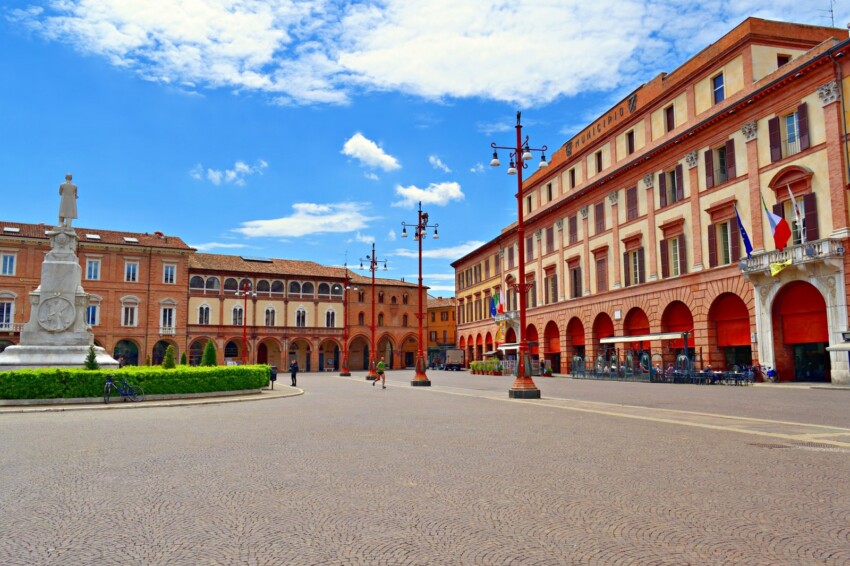
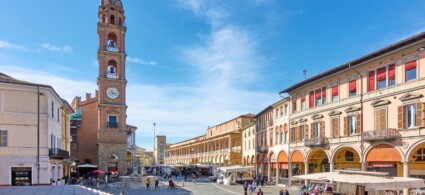
The historic heart of Forlì is Piazza Aurelio Saffi, one of Italy’s largest squares and the centre of the city’s social and cultural life for centuries. The trapezoidal square is surrounded by historically important buildings such as the Palazzo del Podestà, the Rocca di Ravaldino, the Basilica of San Mercuriale and at its centre hosts the statue of Aurelio Saffi (1819–1890), an important figure in the Italian Risorgimento. During the Fascist period the square underwent many interventions, particularly in the buildings on the north side where the Post Office and State Offices buildings are located.
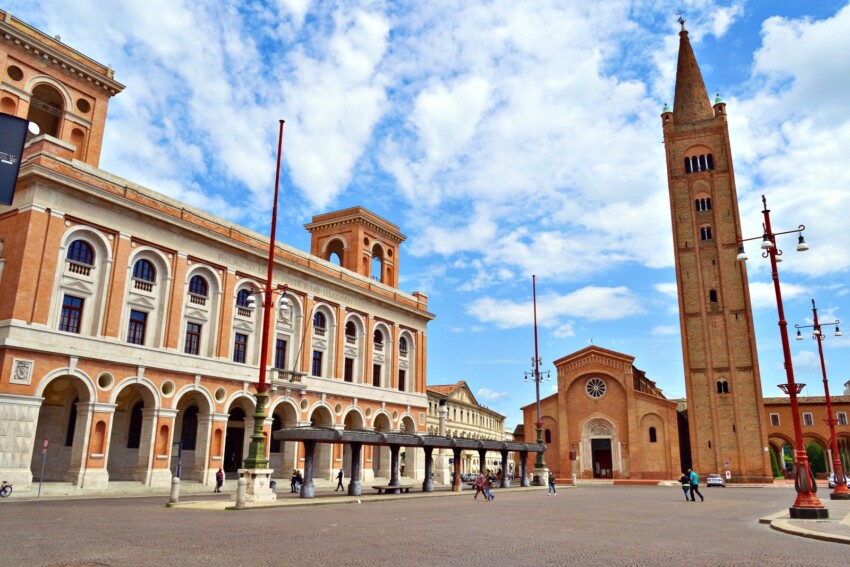
The earliest records of a church at this site date back to the end of the 9th century, but the Basilica was actually rebuilt in 1181 and expanded several times afterwards. During the Fascist era, moreover, at the direct behest of Benito Mussolini both the Piazza and the Basilica underwent major restoration work and have thus come to their current splendour.
The church was built in Forlì red brick with a façade featuring three projecting sections that correspond to the three internal naves and a large central portal crowned by an elegant lunette from the 13th century. The bell tower in Romanesque style has a square floor plan and at 86 metres is famous for being one of the tallest in Italy.
The interior of the church has a basilical layout with three naves divided by brick columns, and the side naves are frescoed with lunettes created by Livio Modigliani and frescoes by Guglielmo degli Organi. In the right nave there is also a 16th-century holy water basin built in local stone that once served as a baptismal font.
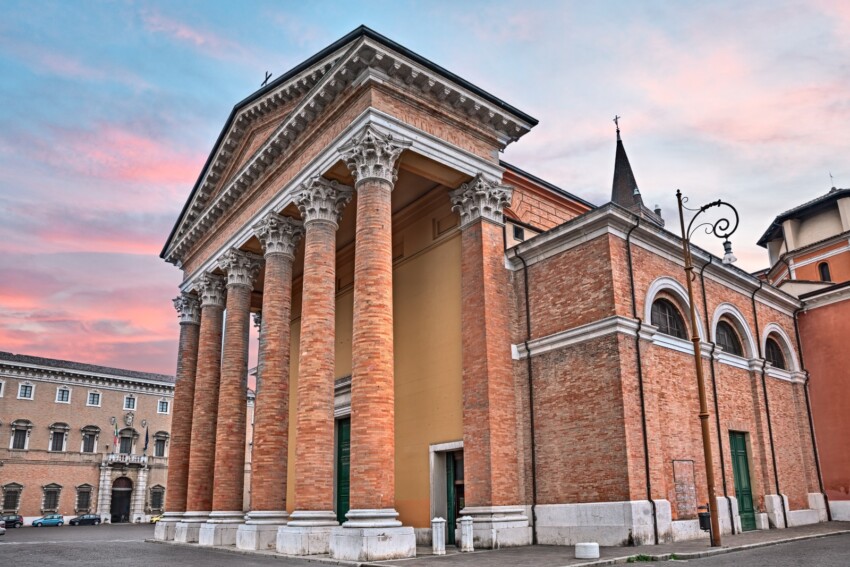
The Duomo of Forlì is also known as the Cathedral of Santa Croce and is famous for housing sumptuous side chapels and a woodcut of the Madonna del Fuoco. Its current neoclassical appearance is the result of reconstruction work carried out in the 19th century following the destruction of the original Romanesque-Gothic church. From the previous church we have retained the Cappella del Santissimo Sacramento in the right nave and the large chapel of Madonna del Fuoco in the left nave. It is precisely in this chapel that the precious woodcut of the Madonna del Fuoco, created between the 14th and 15th centuries, is housed, and it is for this reason one of the oldest paper woodcuts in Europe.
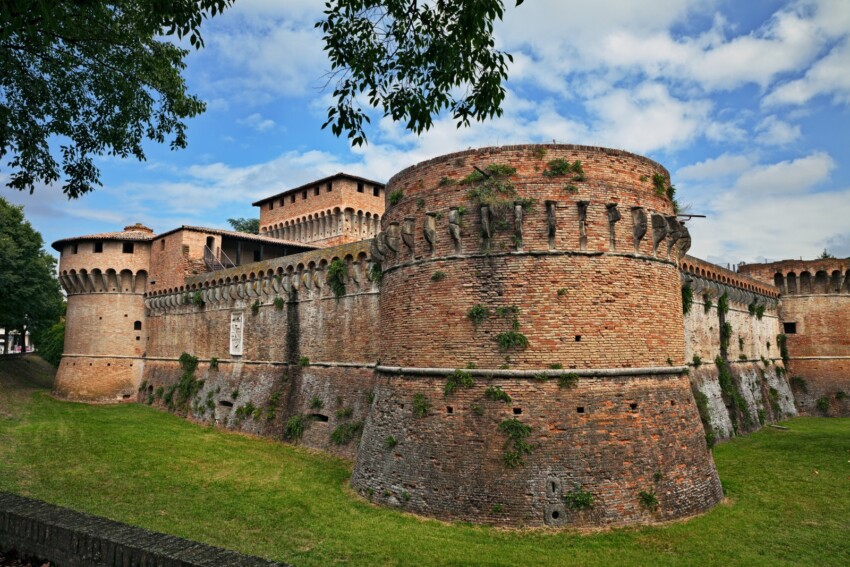
Built in the 14th century outside the historic city centre, the Rocca di Ravaldino is a defensive fortification that played a fundamental role in Forlì’s history. It consists of a massive medieval fortress with circular towers and a mighty perimeter wall built to protect the inner citadel.
Much of the site has been rebuilt several times and what we can admire now is a version remade in the 1960s. It is possible to follow a particular visiting route of the interiors but especially the exteriors, which allow you to enjoy a spectacular view of the city.
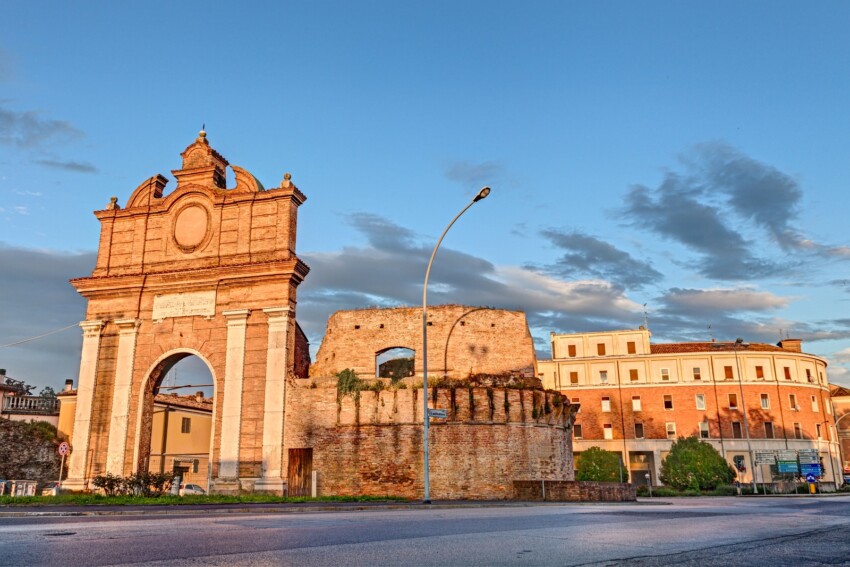
The Porta degli Schiavi, or Porta Schiavonia, is one of the ancient medieval gates of Ferrara, located at the eastern end of Corso Giovecca. Built in the 13th century and renovated in 1590, it represented an important access point to the city for those coming from Comacchio and the Adriatic Sea. The name probably derives from the presence of Slavic merchants (“schiavoni”) who used this route for their commerce. Today the gate, with its red brick structure, retains its historical charm intact.
Located within an ancient Dominican convent, the Musei San Domenico is a museum complex consisting of five buildings that house the Pinacoteca and the civic museums of Forlì. The structures included in the site are Palazzo Pasquali, the church of San Giacomo Apostolo, the Convent of the Dominicans, the Convent of the Augustinians and the Sala Santa Caterina.
Following various restoration interventions, the complex now offers a journey through art and history, with works spanning from the Middle Ages to the modern era. In the pinacoteca, in particular, there are works by local artists such as Melozzo da Forlì, while in the other rooms you will find works from the 16th-century Romagna, the Renaissance and the 20th century.
The Palazzo Romagnoli was built at the beginning of the 19th century by the homonymous family of Forlì origin who wanted a residence worthy of their noble origins. Specifically, in 1806 Lorenzo Romagnoli was elected prefect of the city during the Napoleonic period and had the building constructed which we can now admire with its elegant decorations.
Currently inside it houses part of the collections of the Civic Museums of Forlì with a particular focus on modern and contemporary art works. Specifically, on the ground floor you will find the Verzocchi Collection, a unique collection of paintings dedicated to the theme of work desired by entrepreneur Giuseppe Verzocchi in the 1950s.
For those wishing to immerse themselves in nature’s greenery, the Parco Urbano Franco Agosto is the ideal place thanks to its 26 hectares of space. Located just steps from the city centre, along the Montone River, the Park has been named after Franco Agosto, the first mayor of Forlì following liberation from Fascism.
The park extends over a vast green area with small lakes, walking paths, wildlife and play areas for children. It is a perfect place for a leisurely stroll, to read a book or engage in sports activities thanks also to the presence of football, volleyball and basketball courts.
In the following map you can see the location of the main places of interest mentioned in this article.
Forlì is not a very large city and can be easily navigated on foot, so the best area to stay is the historic centre to have the main tourist attractions and numerous restaurants within easy reach.
Forlì offers several accommodation options to meet the needs of all types of traveller; the area around Piazza Aurelio Saffi boasts higher-level facilities such as hotels and boutique hotels, whilst the university area offers more budget-friendly accommodation.

Forlì is easily accessible from various Italian cities thanks to its strategic location and the numerous transport options available. Those travelling by car can use the Italian motorway network as Forlì is located along the A14 motorway linking Bologna to Rimini and Ancona. From Bologna, it is possible to reach Forlì in about 1 hour by car, whilst from Rimini the journey takes approximately 50 minutes. Alternatively, there is the Via Emilia State Road 9 which connects it with many regional capitals, or the Tosco-Romagnola State Road 67 which connects it with both Ravenna and the Tuscan cities of Florence and Pisa.
Forlì’s railway station is an important hub along the railway line connecting Bologna to Ancona, so frequent trains are available linking Forlì with the main Italian cities. The train journey from Bologna to Forlì takes about 45 minutes, whilst from Rimini the travel time is approximately 30 minutes.
Forlì is also equipped with its own airport named after the Italian aviator Luigi Ridolfi, which is less than 6 km from the city centre and is connected to it via local bus lines. Alternatively, about 75 km away is Bologna’s international airport “Guglielmo Marconi”.
What's the weather at Forlì? Below are the temperatures and the weather forecast at Forlì for the next few days.
In the Romagna area, nestled within the Po Valley between the hills of the Tuscan-Romagnol Apennines foothills and the Adriatic coast, lies the welcoming town of Forlì. Its strategic location makes it an excellent starting point for exploring other fascinating destinations across the region. Specifically, Forlì sits approximately 70 km from Bologna, 55 km from Rimini and 30 km from Ravenna.
 Hotel
Hotel  Budget accommodations
  Apartments
  Family Hotel
  Luxury Hotel
  Resorts