Ferrara: City Highlights Walking Tour with Local Guide
266 reviews
Buy now
From 16,00€ per person
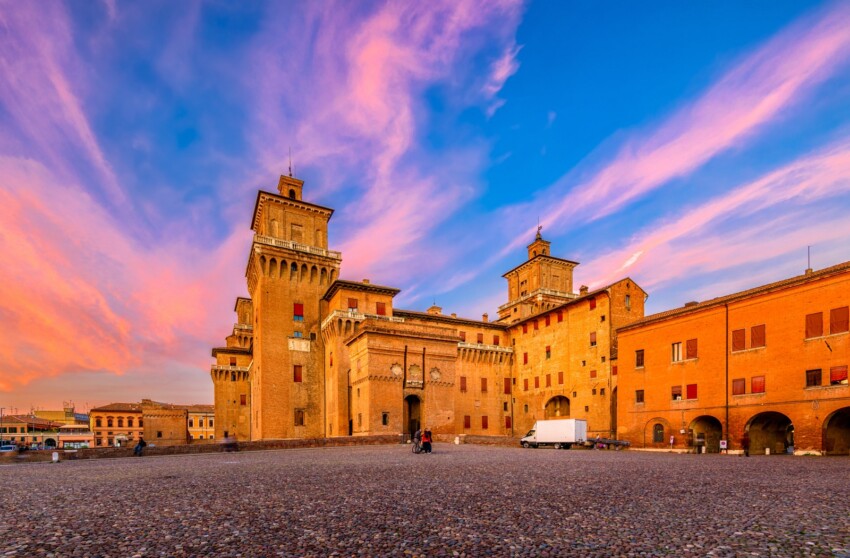
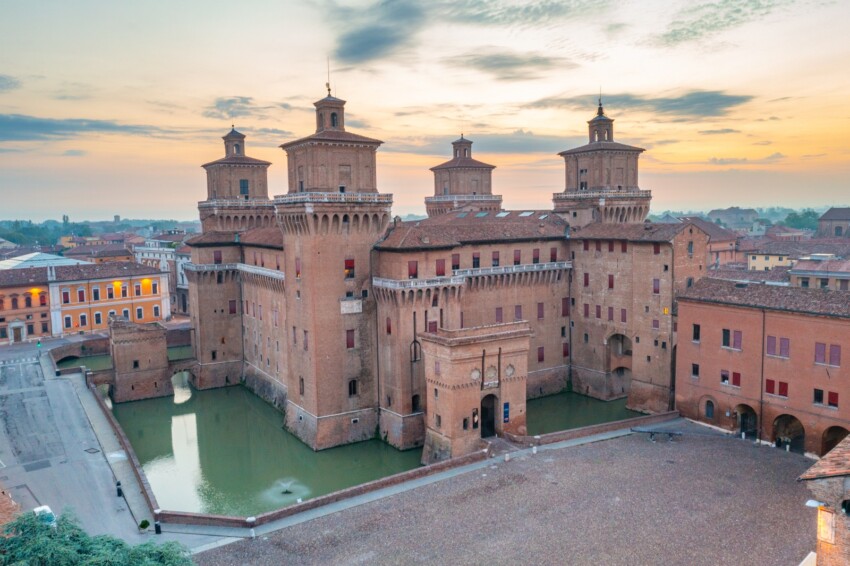
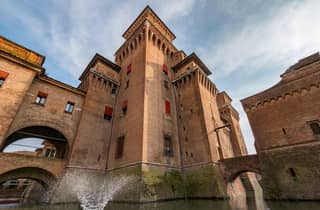
The Castello Estense, also known as the Castello di San Michele, stands majestically in the heart of Ferrara, an undisputed symbol of the Este family’s power and silent witness to over seven centuries of history. This imposing fortress, surrounded by its characteristic water-filled moat, represents one of the most significant examples of Renaissance castle architecture in Italy.
Built in 1385 at the behest of Nicolò II d’Este in response to a dangerous popular uprising, the castle has undergone numerous transformations over the centuries, evolving from an austere defensive fortress into a refined ducal residence. Its four mighty towers, Ghibelline crenellations and drawbridges still tell tales of power, court intrigue and artistic splendour today.
Inside, visitors can immerse themselves in a journey through richly decorated rooms, ducal apartments and underground prisons, testament to the dual nature of this structure: on the one hand a seat of power and centre of court life, on the other a symbol of strength and control over Ferrara territory.
The Castello Estense offers visitors a journey through centuries of history, art and architecture. Every room, every corridor tells a different story of court life and Este power.
Your first encounter with the castle’s interior comes through the magnificent Cortile d’Onore (Court of Honour), an elegant Renaissance space surrounded by a portico with marble columns. Here you can admire the sixteenth-century staircases leading to the upper floors and the balanced architectural harmony that characterises the entire complex.
The Ducal Apartments represent the heart of Este court life. The rooms are embellished with Renaissance frescoes and finely decorated wooden ceilings. Of particular interest is the Sala dell’Aurora, with its pictorial cycle dedicated to the hours of the day, and the Camera delle Duchesse, where you can admire splendid frescoes celebrating court life.
The Loggia degli Aranci (Orange Loggia), once a hanging garden where rare citrus fruits were cultivated, offers a striking view over the city. This space, used by the court for leisure time, represents a perfect example of how the Este family managed to combine beauty with functionality.
In the castle’s basement you’ll find the ancient prisons, including the famous cell where Parisina Malatesta was imprisoned—the young wife of Nicolò III d’Este, condemned to death along with her lover Ugo, the illegitimate son of Nicolò himself. These austere spaces tell the darkest chapter of the castle’s history.
The Torre dei Leoni (Lions’ Tower), the oldest of the four towers, offers breathtaking panoramic views over the city of Ferrara. From here you can appreciate the medieval and Renaissance architecture of the historic centre and understand the castle’s strategic importance.
Access to the Castello Estense offers different ticket types to suit every visitor’s needs.
A full ticket costs €12 and includes access to all areas of the castle open to visitors. There is also a reduced ticket available at €10 for university students, over-65s and groups of at least 15 people. Entry is free for under-18s, people with disabilities and their companions.
You can purchase tickets directly at the castle’s ticket office or book them online through the official website, an option recommended especially during peak season.
Guided tours are the best way to discover the secrets and history of the Castello Estense. The service is available in Italian and major foreign languages. The average duration of a guided tour is approximately 90 minutes and includes all the castle’s main rooms, with insights into the Este family’s history, architectural and artistic features of the complex.
The Castello Estense is one of the essential stops on any guided tour of Ferrara.
The Castello Estense observes the following opening times.
March to October: daily from 9:30 am to 5:45 pm (last admission at 5:00 pm); November to February: daily from 9:30 am to 5:15 pm (last admission at 4:30 pm).
The castle is closed on 25 December and 1 January. During major public holidays, opening times may vary, so it’s advisable to check the official website.
A visit to the Castello Estense typically requires 2-3 hours to be fully appreciated. To make the most of your experience, here are some practical tips.
The best time to visit is during the morning, when it’s generally less crowded. Spring and autumn months offer more pleasant temperatures for exploring the castle’s interior spaces.
We recommend wearing comfortable shoes, as the visit route involves several staircases and uneven surfaces. During summer months, the interior spaces remain cool, so it’s advisable to bring a light layer of clothing.
For photographers, the best light for photographing the castle’s exterior is during the early morning or late afternoon hours. Photography without flash is permitted inside.
The Castello Estense is located in Ferrara’s historic centre and is easily accessible by various means of transport.
If you’re arriving by car, we recommend parking in one of the numerous car parks outside the historic centre and continuing on foot. The Ex MOF car park and the Historic Centre car park are among the most convenient, both about a 10-minute walk from the castle.
Ferrara railway station is connected to major Italian cities. From the station square, the castle is reachable on foot in about 15 minutes via Corso della Giovecca, or by using urban buses (lines 1, 9 and 11).
Ferrara’s centre is served by an efficient urban bus system. The closest stops to the castle are “Castello” and “Cattedrale”, both just a few steps from the entrance.
The Castello Estense stands in the heart of Ferrara, at the intersection of Corso Martiri della Libertà and Corso Ercole I d'Este.

 Hotel
Hotel  Budget accommodations
  Apartments
  Family Hotel
  Luxury Hotel
  Resorts