Ferrara: City Highlights Walking Tour with Local Guide
258 reviews
Buy now
From 16,00€ per person
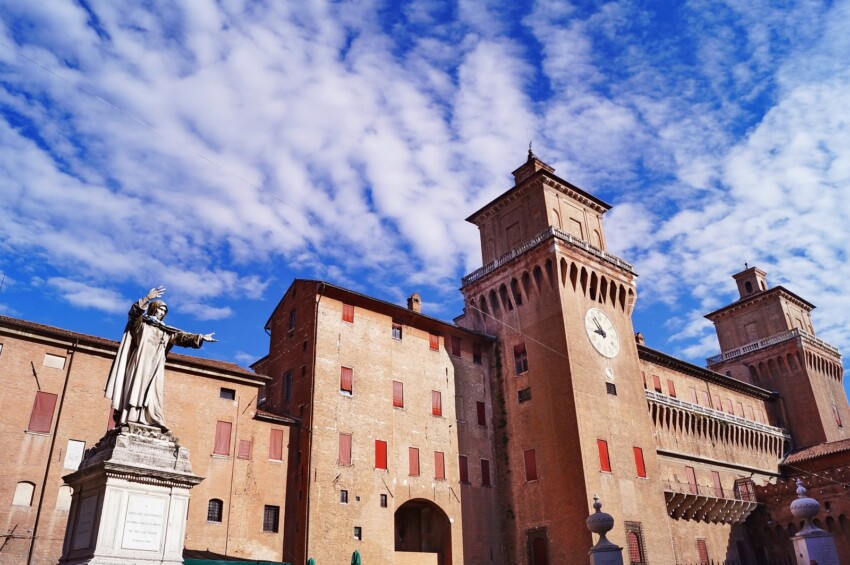
Ferrara is a magnificent city in Emilia-Romagna brimming with history and culture, its historic centre designated as a UNESCO World Heritage Site in 1995. The city’s urban development took place during the Renaissance when Ferrara served as capital of the Duchy of Ferrara, Modena and Reggio, and thanks to the creation of a new urban plan known as the Addizione Erculea, it earned the title of “Europe’s first modern capital”.
During the rule of the Este family, which lasted nearly three centuries, Ferrara became the principal city of a small yet culturally vibrant state, attracting important artists and scientists over the years. In the fourteenth century, a significant University was established here, which saw the participation of figures such as Nicolaus Copernicus, Giovanni Pico della Mirandola and Gabriele Falloppio.
Today, Ferrara is renowned for its historic University and its impressive artistic, architectural and cultural heritage; the city has also managed to preserve a well-maintained historic centre filled with sites of interest enclosed within imposing city walls.
The historic centre of Ferrara as we see it today took shape in the fifteenth century at the behest of Duke Ercole I d’Este, who entrusted the work to his court architect Biagio Rossetti. The duke’s ambitious urban planning project, later known as the Addizione Erculea, envisaged not merely an expansion of the city’s boundaries but a fresh approach to urban design rooted in the concept of the ideal city. Realised between the late fifteenth and early sixteenth centuries, the project aimed to elevate Ferrara and its court to the standing of Europe’s most important courts of the time, though parts of the land within the city walls were only developed in the centuries following Ercole I’s initial scheme.
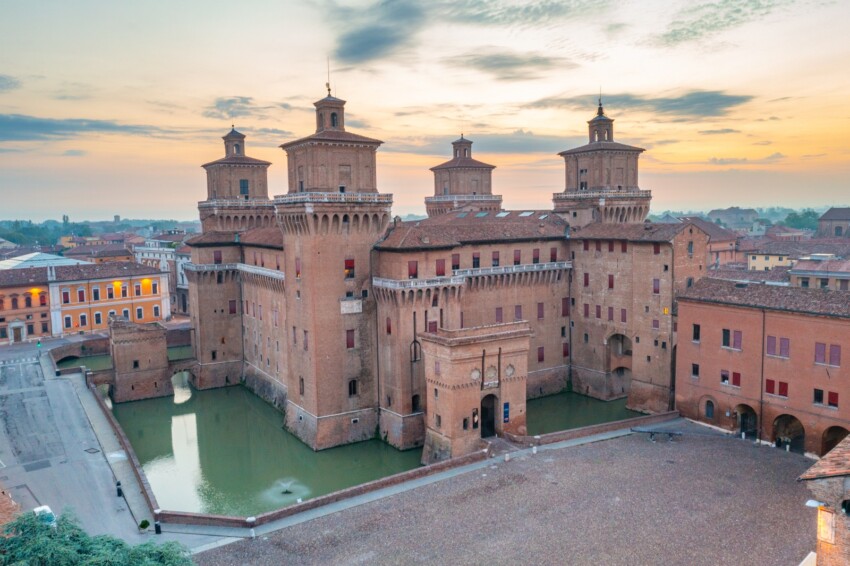
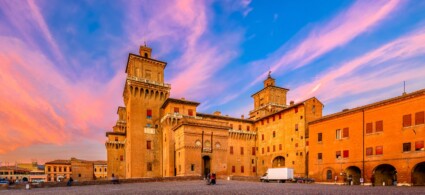
Any visit to Ferrara must begin at the Castello Estense, commissioned by Marquis Nicolò II d’Este and for centuries the driving force in the city’s history and a symbol of the region. Construction began in 1385, specifically on 29 September, a date dedicated to St Michael, the warrior archangel who leads the heavenly hosts, which is why the fortress is also known as the Castello di San Michele. The complex is an imposing stronghold surrounded by a water-filled moat that over time served various purposes: from defence to serving as the Este family’s court residence. The fortress’s original design was executed by architect Bartolino da Novara, who had gained renown for his work on the Visconti Castle in Pavia and was engaged by Nicolò II following this success.
The marquis sought a fortified structure to protect against not only enemy attacks but also popular uprisings. Over time, the complex underwent various modifications that transformed it increasingly into a noble residence, with the Este family occupying the upper floors whilst the lower levels served defensive purposes, housing stables, armouries and storerooms. Today, a visit to the castle allows you to admire the court apartments, as well as the kitchens, dungeons, chapel, Games Room and Government Hall. The tour offers a genuine journey through time, discovering how the Este family, one of Europe’s most powerful dynasties, lived their daily lives. Don’t miss the four towers, particularly the Torre dei Leoni, from whose summit you can enjoy a magnificent panorama of the entire city.
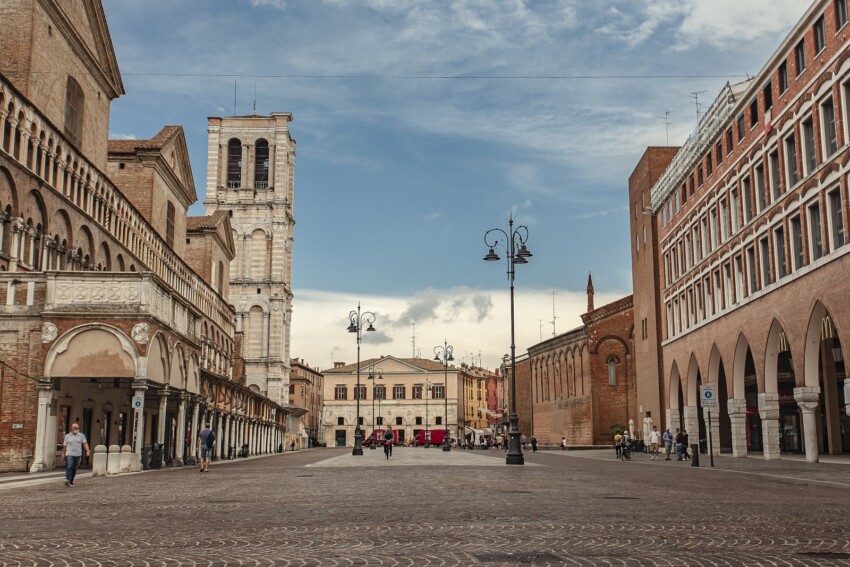
Piazza Trento e Trieste, known until 1919 as Piazza delle Erbe, is the true heart of Ferrara, hosting the city’s principal buildings and points of interest. Here you’ll find the Cathedral of San Giorgio with its adjacent museum, the Loggia dei Merciai, the Teatro Nuovo, Palazzo della Ragione, the Torre della Vittoria and the Palazzo Municipale. The square also features the listone, a long 120-metre pavement surrounded by various arcades housing bars, historic cafés and shops that make this area a hub for locals. For centuries, the city’s fruit and vegetable market has taken place here, and during the festive season, the traditional Christmas market sets up its stalls.
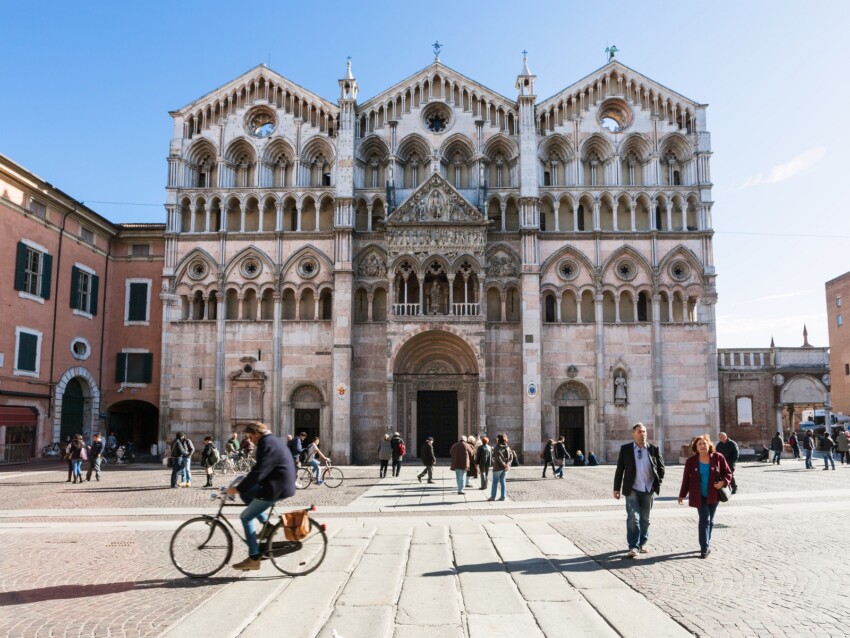
The Cathedral of San Giorgio, or Ferrara’s Duomo, is a church built around the twelfth century in Romanesque-Gothic style, standing a short distance from the Castello Estense. It is a true masterpiece of architecture designed by architects Nicholaus and Guglielmo degli Adelardi. The exterior immediately captivates with its white marble façade and beautiful portico, which boasts a central portal depicting scenes from the life of Christ below and St George slaying the dragon above.
On the façade, beside the statue of Alberto V d’Este, stands an important inscription referencing a papal bull issued by Pope Boniface I on 4 March 1391, establishing the University of Ferrara. The exterior also impresses with its Renaissance bell tower in white and pink marble, said to have been conceived by Leon Battista Alberti, though it was left incomplete.
The interior of the Cathedral has a three-nave layout, though much of the structure was rebuilt in Baroque style in the seventeenth century following a devastating fire. The side chapels feature fine frescoes with numerous paintings by important artists such as Guercino, Garofalo and Francesco Francia, whilst the apse displays a fresco of the Last Judgement painted in 1580 by Bastianino.
Also not to be missed is the Cathedral Museum, located in the nearby former Church of San Romano, where you can admire works such as Jacopo della Quercia’s Madonna of the Pomegranate and various canvases by Filippo Solari, Andrea da Carona and Bernardo Rossellino.
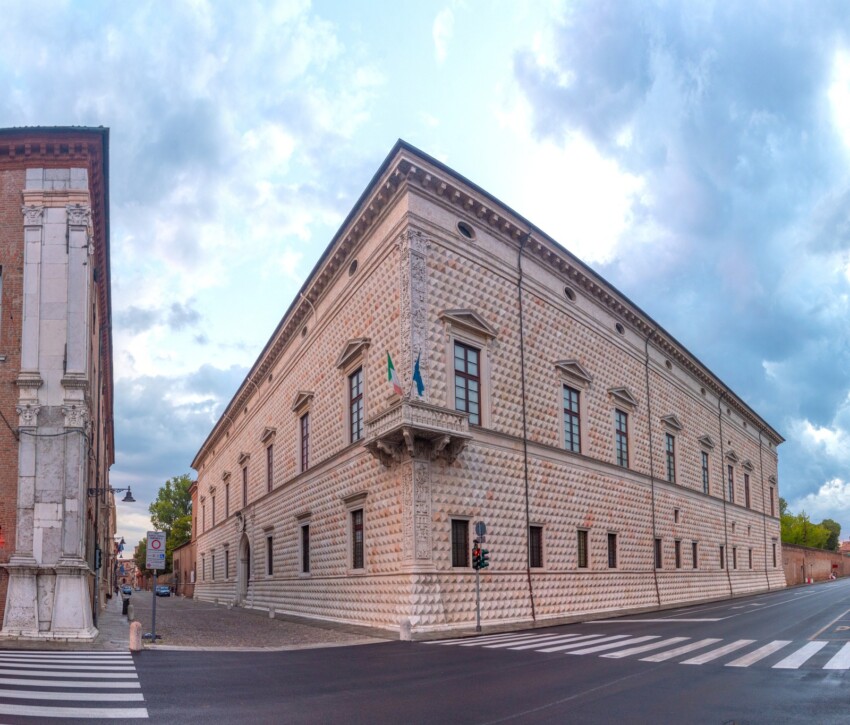
Another essential stop in Ferrara is Palazzo dei Diamanti, considered a masterpiece of Renaissance architecture conceived in 1493 again by Biagio Rossetti as part of the so-called “Addizione Erculea”, the city’s expansion commissioned by Ercole d’Este. Its name derives from the 8,500 blocks of marble arranged in a diamond pattern that make up the façade, creating striking effects of light and shadow. Originally inhabited by members of the Este family, in particular serving in 1586 as the residence of Cesare d’Este, cousin of Duke Alfonso II, and his wife Virginia de’ Medici, who commissioned the decoration of parts of the palace with frescoes by Giulio Belloni and his students.
Today the Palazzo houses the National Gallery of Modern and Contemporary Art, the Picture Gallery, and frequently hosts important exhibitions and events of international standing. The building features a typical Renaissance courtyard with cloister, a handsome Renaissance courtyard and a marble well. The Picture Gallery contains paintings of the Ferrarese school dating from the thirteenth to seventeenth centuries, featuring works by artists including Andrea Mantegna, Serafino de’ Serafini, Gentile da Fabriano and Cosmè Tura.
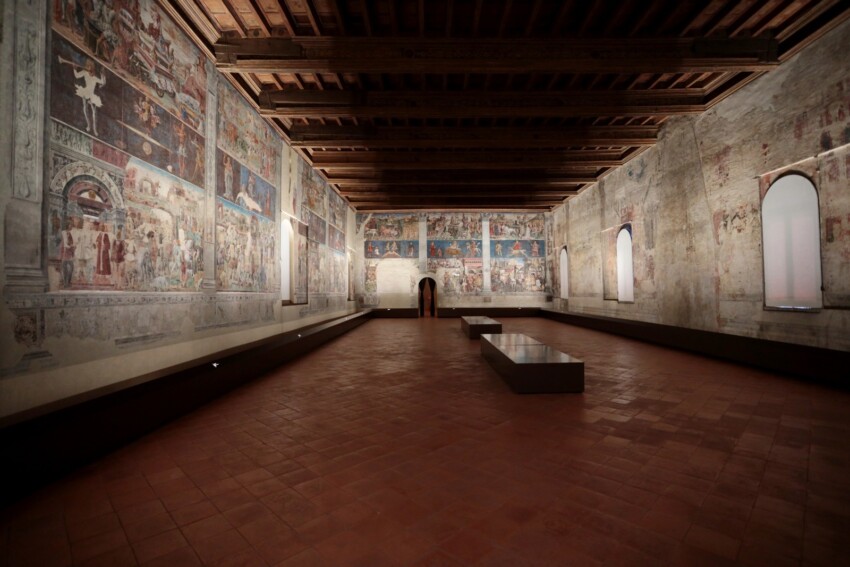
Palazzo Schifanoia is among what are known as the “delizie estensi”, residences built by the Este family during the Duchy of Ferrara when its territories also encompassed Modena and Reggio Emilia. The building was constructed in 1385 on the orders of Alberto V d’Este but subsequently enlarged first by Borso d’Este and later by Ercole I d’Este, who again assigned the project to his court architect Biagio Rossetti. The name “Schifanoia” comes from the notion that this was a place to “chase away boredom” and thus to relax and enjoy oneself.
The visit comprises several beautifully frescoed rooms, culminating on the piano nobile with the famous Hall of the Months, one of the most significant examples of fifteenth-century Italian painting, commissioned by Borso d’Este. The hall’s frescoes were executed by the most celebrated figures of the Ferrarese school of the time, including Francesco del Cossa and Ercole de’ Roberti, who depicted the life and deeds of Duke Borso using elements from mythology and astrology.
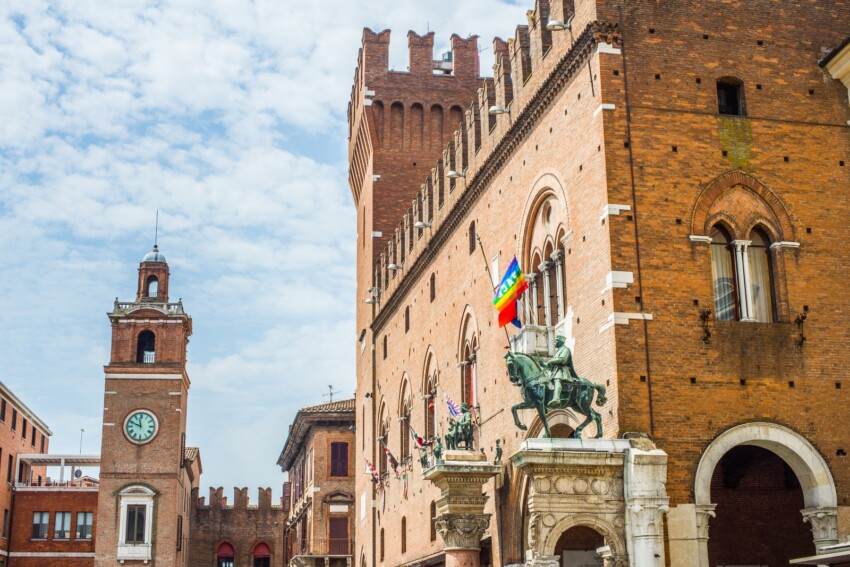
The original home of the Este dynasty is what is now called the Palazzo Municipale, begun in 1245 but subsequently modified and enlarged many times until reaching its current dimensions around 1481. The noble family lived here before moving to the Castello Estense, though the two buildings were later connected by a passage known as the via Coperta. The main façade of the palace was originally positioned directly in front of the cathedral to emphasise the importance the city’s sovereigns attached to both political and religious authority.
The main entrance to the palace was also known as the Volto del Cavallo because it was flanked by equestrian statues of Marquis Niccolò III and Duke Borso d’Este depicted dispensing justice. Beyond the Volto del Cavallo lay what was once the ducal courtyard, now transformed into Piazza del Municipio, where you can see the grand staircase designed by Pietro Benvenuto degli Ordini in 1481, the marble windows of the Este apartments (where Lucrezia Borgia also lived) and the former Court Chapel, now the Estense Hall. In the early twentieth century, the building underwent extensive restoration and enlargement, including a complete reconstruction of the main façade executed in Neo-Gothic style.
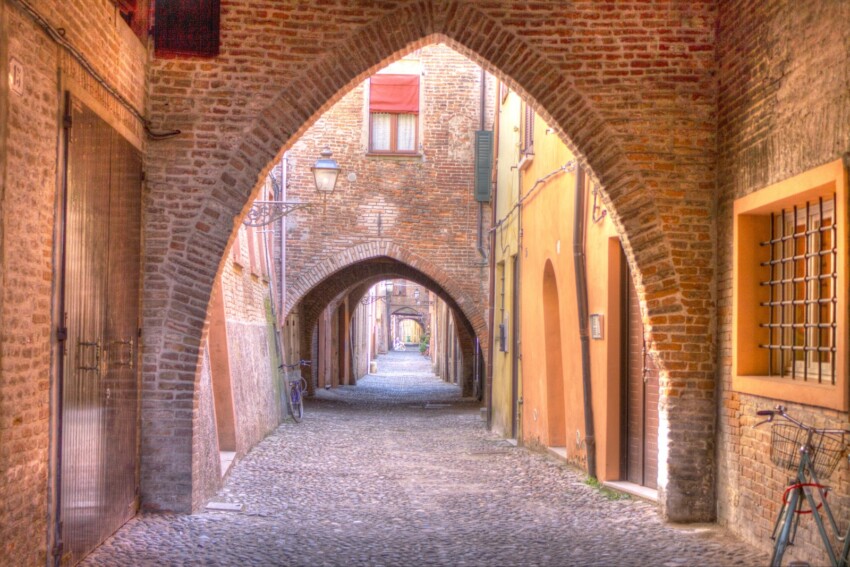
Don’t miss the chance to explore one of Ferrara’s historic streets, Via delle Volte, which has a truly distinctive and evocative atmosphere, being the axis along which the city developed between the eighth and eleventh centuries. Via delle Volte is a 2 km cobbled street that traverses the city, and in medieval times, before the Po River was diverted, this area housed the warehouses and merchants’ shops dealing in trade with the rest of Italy, making use of the river.
Its name comes from the presence of numerous vaults and arches that connected the storage area along the watercourse with the interior buildings housing shops and residences. Along this street stands the Torre dei Leuti dating to the tenth century, and of the 32 communal-era towers, it is the only one to have survived. Once its commercial function ceased, the street fell into disrepute for a long period, often frequented by prostitutes and criminals.
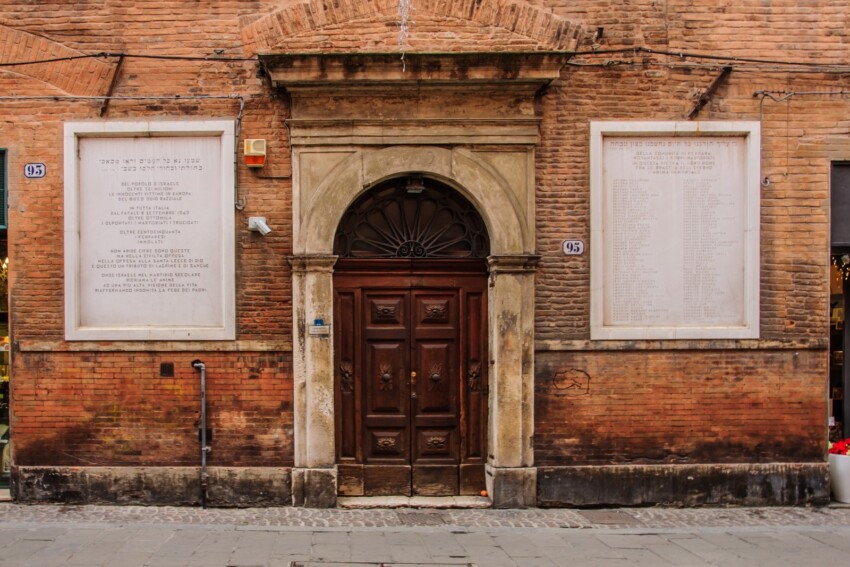
The city of Ferrara has long had a strong bond with its Jewish community even before the Este family came to power. It was towards the end of the fifteenth century, under Ercole I d’Este, that the city welcomed in large numbers Jews expelled by the Catholic monarchs of Spain. From then on, the Jewish community and its culture increasingly integrated with Ferrarese society, becoming an integral and defining part of it. Following the fall of the Este dynasty, Ferrara came under Papal States rule and Jews were confined to the ghetto area located near Piazza delle Erbe until Italian unification.
Walking through this area, you can still admire several synagogues as well as Jewish establishments such as the bakery, butcher and school, which after the racial laws provided education for Jewish pupils excluded from state schools. It was here that Giorgio Bassani, a writer and political activist of Jewish descent, also taught and was later buried in the small Jewish cemetery in the area. Be sure to visit the National Museum of Italian Judaism and the Shoah (MEIS), which offers an exhibition on Italian Jews, their history and the persecutions they endured over the centuries.
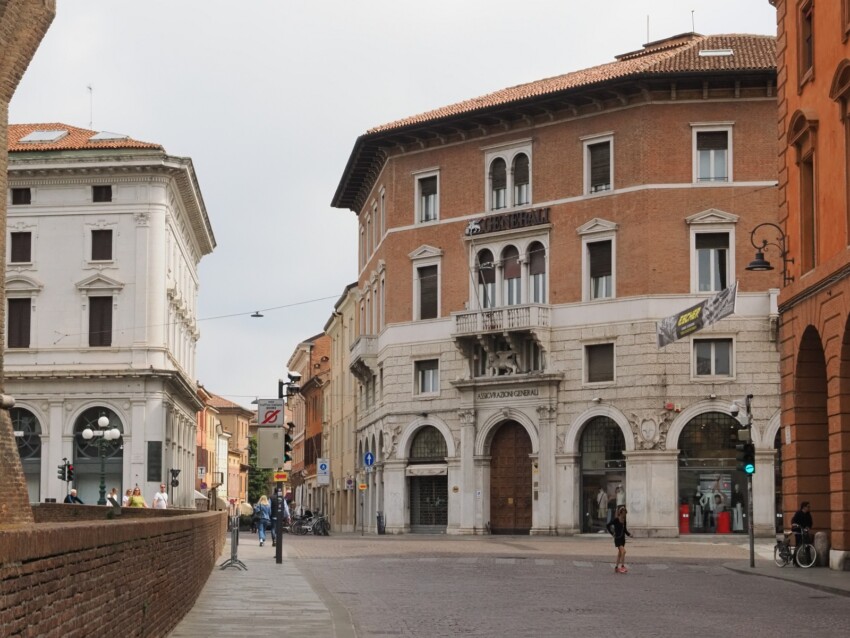
Another celebrated street in Ferrara is Corso Ercole I d’Este, which begins at the Castello Estense and ends close to the city walls near the Porta degli Angeli. The street was originally known as via degli Angeli as it once housed the ancient church dedicated to Santa Maria degli Angeli, now long gone. This is considered the main axis of the so-called Addizione Erculea, the grand urban planning project commissioned from court architect Biagio Rossetti by Duke Ercole I d’Este and completed in the early sixteenth century.
The Corso is currently pedestrianised and surrounded by numerous elegant buildings and Renaissance palaces belonging to the Este family or other noble families, such as palazzo Gulinelli, palazzo Scola, the former Monte di Pietà palace and the palace of Giulio d’Este. The most significant point along the Corso and indeed of Rossetti’s entire urban scheme is the so-called “Quadrivio degli Angeli“, home to Palazzo dei Diamanti, Palazzo Turchi di Bagno, Palazzo Prosperi-Sacrati and Palazzo Bevilacqua, currently housing the police barracks.
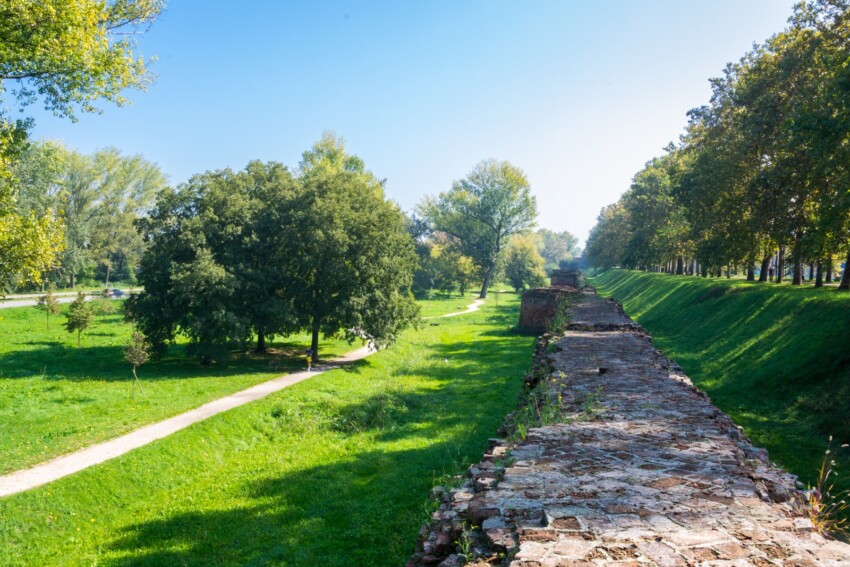
The city walls encircling Ferrara’s historic centre were first built during the medieval period and originally stretched for a total of 13 km, though they have been modified many times since. Regarded as a fine example of urban architecture, Ferrara’s walls were so magnificent and important that they were studied by great artists such as Michelangelo. They also boasted four main entrances, of which the Porta degli Angeli, on the northern side, was considered the principal gate as it was used by the dukes and important guests.
Around the entire perimeter, the walls featured mighty bastions constructed to withstand enemy siege and attack, fitted with gun emplacements and loopholes. On the southern side near the Porta dell’Amore, the Baluardo dell’Amore still stands, built shortly after 1451 and in good condition. Now stretching roughly 9 km, Ferrara’s walls are perfect for exploring on foot or better still by bicycle, the most popular way to get around the city.
In the following map you can see the location of the main places of interest mentioned in this article.
If you’d like, you can join a guided tour of Ferrara to fully appreciate and discover the city’s main attractions and hidden gems. Professional guides not only explain the history of the places you visit, but also share anecdotes, fascinating facts and practical tips about Ferrara.
Ferrara boasts a wonderfully human-scale city centre that’s absolutely delightful to explore, especially by bicycle – one of the most popular ways to get around this territory rich in historic sites and attractions. The best area to stay during a visit to Ferrara is undoubtedly the city centre within the walls, where you’ll find not only numerous hotels, including upmarket ones, but also charming bed and breakfasts and apartments. Some accommodations have been converted from historic noble palaces into characterful properties. Another option is to stay outside the city centre, where you’ll find numerous farmstays and facilities nestled in the countryside.
Ferrara is easily accessible by car or public transport thanks to excellent road and rail connections. The city is connected to the Italian motorway network via the A13 motorway (Bologna-Padova), which also passes through Rovigo and links to other Italian motorways such as the A1 (Milan-Naples) and the A14 (Bologna-Taranto). Another way to reach this destination is via rail services, as Ferrara’s RFI railway station is served by both regional and national connections, allowing you to reach the main cities of Lombardy, Veneto and Emilia-Romagna.
What's the weather at Ferrara? Below are the temperatures and the weather forecast at Ferrara for the next few days.
Ferrara is a charming town in Emilia-Romagna, situated close to the Veneto border. The city lies 40 km from Rovigo, 50 km from Bologna and 110 km from Venice.
 Hotel
Hotel  Budget accommodations
  Apartments
  Family Hotel
  Luxury Hotel
  Resorts