Bestseller
From Bologna: Roundtrip San Luca Train Ticket & Food Tasting
From 37,00 €
Buy the ticket
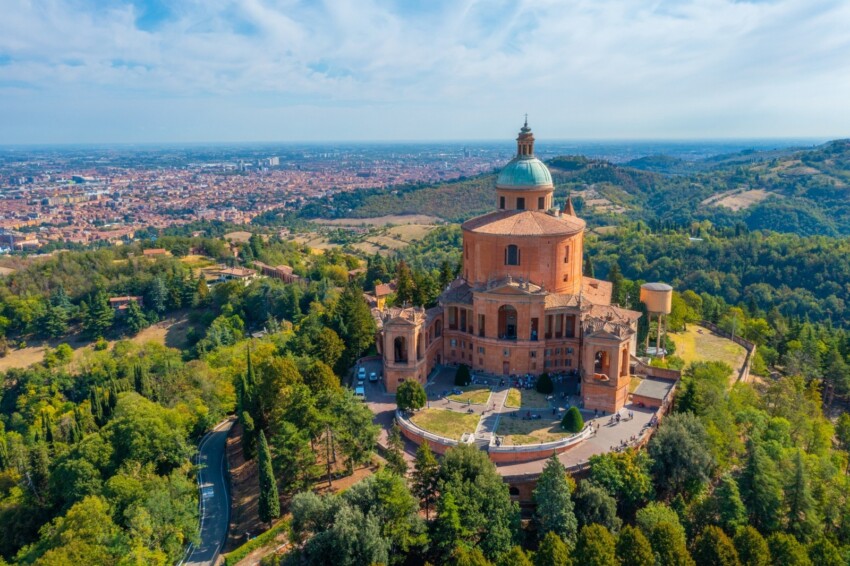
The Sanctuary of the Virgin of San Luca, also known as the Sanctuary of the Madonna of San Luca, is one of the most important religious and cultural sites in the city of Bologna and indeed across the entire Emilia-Romagna region. This sanctuary has truly ancient origins and over time has evolved from a modest chapel into a pilgrimage destination and major tourist attraction.
Perched on the Colle della Guardia, at approximately 300 metres altitude, the Sanctuary has been a pilgrimage destination for centuries, as it is believed to house an icon of the Madonna painted by the evangelist Luke. Moreover, the walking route to reach the Sanctuary begins from central Bologna and consists of a long colonnaded passageway stretching nearly 4 km along the side of the hill; once you reach the summit, you can enjoy a spectacular view over the city and the surrounding hills.
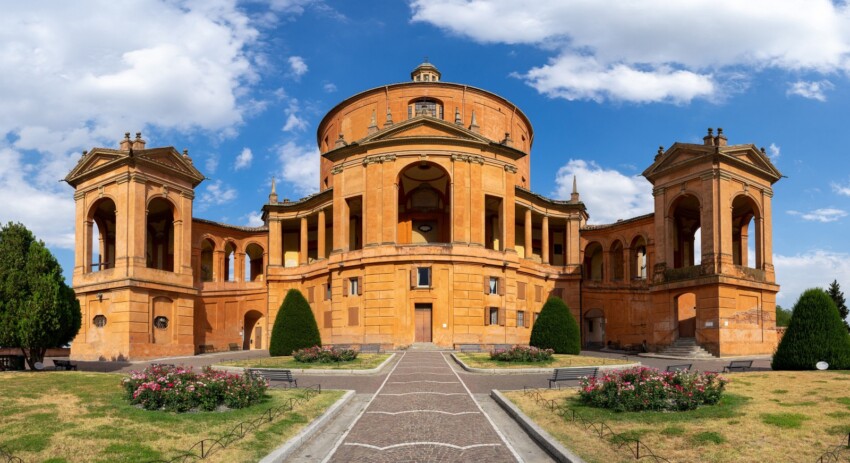
The Sanctuary of the Virgin of San Luca is a magnificent example of Baroque religious architecture, constructed from 1741 onwards to designs by Carlo Francesco Dotti. The main façade is characterised by a portico with three arches and a large triangular pediment decorated with marble reliefs. The building has a circular floor plan, short arms in the form of a Greek cross and a single nave that houses chapels richly decorated with stuccowork and frescoes depicting episodes from the life of the Virgin Mary. Much of the artwork was created by local artists of the time, including Bigari, Giovanni Viani, Nicola Bertoni and Guido Reni, who painted a wonderful Madonna of the Rosary in the third chapel on the right.
The most monumental part of the Sanctuary, however, is without question the drum supporting a majestic dome, which is clearly visible from much of Bologna from the outside and is undoubtedly one of the sanctuary’s most distinctive features. Inside, the dome is adorned with frescoes depicting the glory of the Virgin Mary, executed by painter Giuseppe Maria Crespi and his pupils. The high altar was created in 1815 to a design by Venturoli and boasts precious marble and bronze decorations. Behind the presbytery, a staircase leads to a tribune where, in a niche, the precious icon of the Virgin and Child painted by the evangelist Luke is preserved.
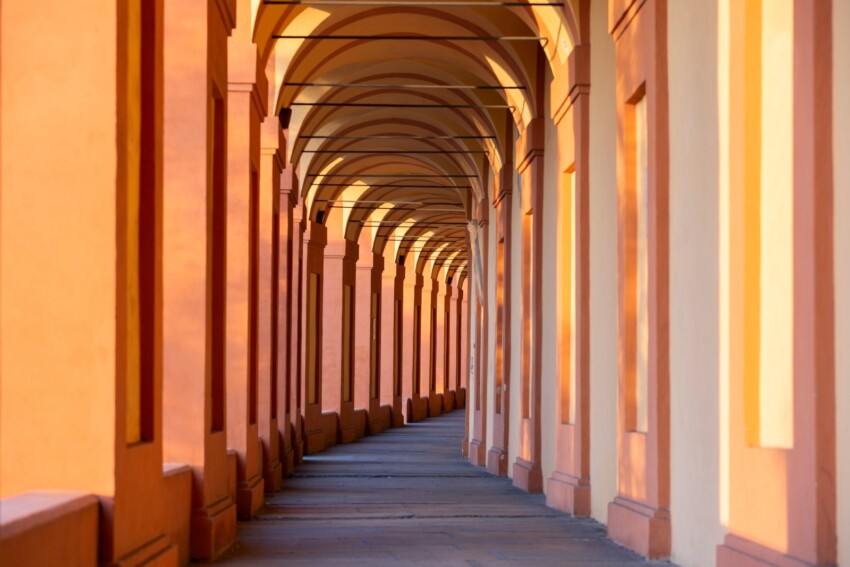
One of the most renowned and admired aspects of the Sanctuary of the Virgin of San Luca is undoubtedly the long portico connecting it to the city centre, which was built in the 18th century for a total length of 3.8 km. This unique colonnaded avenue begins at Porta Saragozza, one of the ancient city gates, and gently ascends to the sanctuary, protecting pilgrims from the elements. Considered an important symbol of faith and devotion, the portico route comprises not only 666 arches but also chapels with the Mysteries of the Rosary, positioned at regular intervals (approximately every 20 arches).
Additionally, the avenue features commemorative plaques and inscriptions from various periods, thanksgiving tablets for donations and ex-votos for favours received. Every year, on the first Sunday in May, a traditional procession takes place, travelling from the Sanctuary along the Portico of San Luca, carrying the sacred icon of the Virgin to the Basilica of San Pietro in the historic centre, where it remains for a week.
The Sanctuary of the Virgin of San Luca can easily be reached from central Bologna on foot, by public transport or by car. On foot from Piazza Maggiore, you need to cover 4.7 km, a large portion of which is the so-called Porticos of San Luca.
Alternatively, if you prefer to travel by bus, you can use line 58, which stops at the main areas of the historic centre before heading to the Sanctuary. The Sanctuary can also be reached by car via the SS64 Porrettana state road heading towards Via di San Luca.
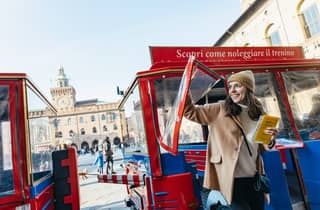
Furthermore, you can reach the Sanctuary with the San Luca Express, a tourist line that connects Bologna’s historic centre with the hilltop where the fascinating Sanctuary stands.
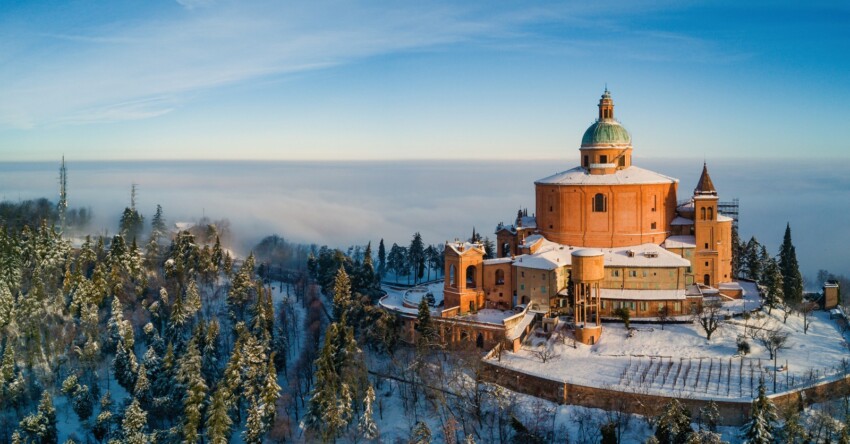
According to the tradition passed down through centuries, the Sanctuary is said to house a sacred icon of the Virgin with the Christ Child that was painted by the evangelist Luke and brought to Bologna in the 12th century by a pilgrim whom some say was named Euthymius and others Thekla. The man had received the precious painting from the priests of the Basilica of Santa Sofia during a pilgrimage to Constantinople, and they had given him instructions to take it to the “mountain of the Guard”, as indicated in an inscription on the painting.
Once the icon arrived in the city, it was taken into the care of nuns in a convent on the Colle della Guardia and subsequently housed in a small chapel built at the behest of Angelica Bonfantini, a member of a wealthy family who had decided to dedicate her life to prayer. The desire to build a sanctuary worthy of housing the panel soon received the support of Pope Celestine III, who also blessed the foundation stone of the church.
Over the centuries, devotion to the Madonna of San Luca grew significantly, and so the small place built to house the icon was repeatedly enlarged to accommodate the ever-increasing number of the faithful. By the early 18th century, however, it became clear that the church, despite its enlargements, was still far too small, and so the sanctuary that we can admire today was built. Between 1723 and 1757, moreover, to protect pilgrims during their journey to the Sanctuary, the portico of San Luca was constructed, extending from Porta Saragozza for approximately 3.8 km to the top of Colle Guasco.
This extraordinary architectural work is one of the longest porticos in the world and is composed of 666 arches, a number that is far from arbitrary given that 6 is the number of the devil, whilst serpents are said to have been designed in the arches. In March 1765, after 42 years of construction work, the new Sanctuary of the Virgin of San Luca was inaugurated and has since welcomed the faithful from all over the world, with a brief closure occurring during the Napoleonic era when it was temporarily shut.
The Sanctuary of the Virgin of San Luca is a place of Marian worship distinguished by profound spirituality. It stands atop Colle Guasco at nearly 300 metres above sea level, commanding views over Bologna's historic centre from this lofty position.

 Hotel
Hotel  Budget accommodations
  Apartments
  Family Hotel
  Luxury Hotel
  Resorts