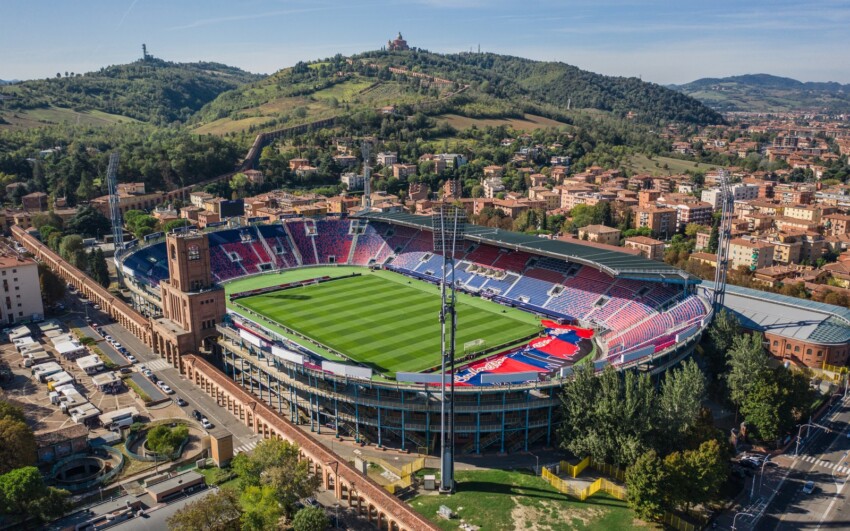
The Stadio Renato Dall’Ara, inaugurated in 1927 under the name Littoriale, stands as one of the most significant examples of rationalist sporting architecture from the Italian period. Located at the foot of Bologna’s hills in the Certosa district, this historic venue boasts a capacity of around 31,000 spectators and is distinguished by its iconic Marathon Tower, the undisputed symbol of the stadium.
The facility offers numerous amenities for spectators: refreshment points distributed throughout the various sections, the Official Bologna FC Store where you can purchase merchandise and tickets, and an interesting museum charting the club’s history. The new renovation project includes further improvements in accessibility and facilities, with particular attention to families and people with disabilities.
The Dall’Ara represents far more than a simple football stadium: it is a symbol of civic identity and an important economic and social asset. The modernisation project forms part of a broader urban regeneration plan for the surrounding area, with the aim of creating a modern and sustainable sports and cultural hub, seamlessly integrated into Bologna’s urban fabric.
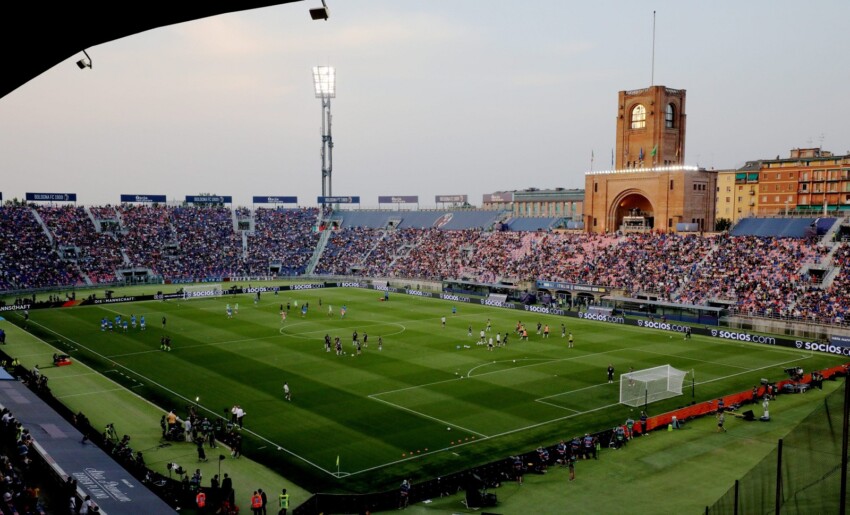
The stadium’s architecture, designed by engineer Umberto Costanzini, draws inspiration from the Fascist style of the era, incorporating elements reminiscent of Roman classical architecture. The monumental Marathon Tower, standing 42 metres high, dominates the complex and is decorated with bas-reliefs celebrating sport. In 1983, the stadium was renamed in honour of Renato Dall’Ara, the Bologna Football Club’s historic president from 1934 to 1964, under whose leadership the team won its last championship titles.
The Dall’Ara has hosted numerous events of international significance, including matches from the 1990 World Cup, when it was the venue for four encounters. The stadium has been the setting for historic Bologna victories and has witnessed performances by great champions of Italian and international football. The facility has also hosted major musical concerts and cultural events, confirming its position as a focal point for the city’s social and cultural life.
The stadium is currently undergoing an ambitious modernisation project featuring significant works to bring the structure in line with modern standards whilst preserving its historical and architectural value. The project includes the complete covering of the stands, bringing the seating closer to the pitch, improving public facilities and implementing energy-efficiency solutions. The capacity will be optimised to around 28,000 seats, all covered and with perfect sightlines.
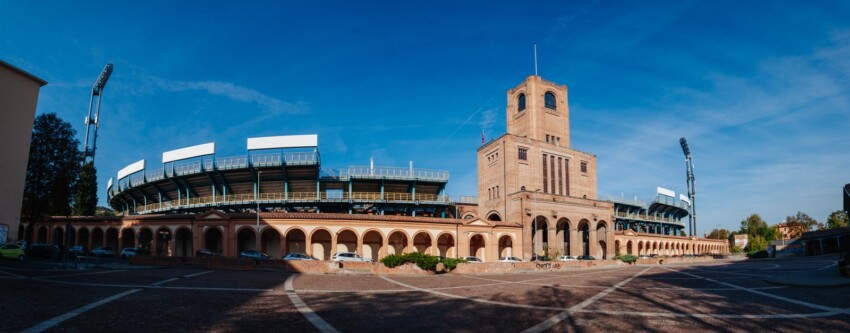
The Marathon Tower, the Dall’Ara stadium’s authentic icon, rises 42 metres into the Bologna sky, majestically dominating the entire sports complex. Designed as a celebratory element, the tower is embellished with significant bas-reliefs depicting athletic figures and sporting scenes, the work of sculptor Farpi Vignoli. The structure, constructed in reinforced concrete and clad in artificial stone, draws inspiration from the architecture of medieval Bologna’s towers, thus blending local tradition with rationalist monumentality.
Inside the tower, a spiral staircase leads to the summit, from where, in times past, officials and dignitaries watched sporting events and public gatherings. Of particular note are the four corner fasces (later modified in the post-war period) and the large clock that still marks the rhythm of match days today. During recent restoration projects, the Marathon Tower underwent conservation work that has preserved its structural integrity and historical-artistic value, confirming it as an undisputed symbol not only of the stadium but of the entire city of Bologna.
The Dall’Ara Stadium is conveniently accessible by various means of transport. By bus, lines 14, 20 and 21 connect directly from the central station to the stadium, with the “Stadio” stop on Via Andrea Costa. On match days, the special shuttle service ‘T20’ operates, linking the city centre to the sports facility. For those arriving by car, the recommended exit from the ring road is number 2 (Borgo Panigale) for those coming from the north and number 1 (Casalecchio) for those arriving from the south.
Several car parks are available nearby: the APCOA area on Via Andrea Costa, the car park on Via dello Sport and the one on Via Della Certosa. For visiting supporters, there is a dedicated car park on Via Talvera. Those preferring to travel by bicycle will find numerous racks around the stadium and can use the cycle paths that connect the city centre to the sports facility area.
Bologna Football Club 1909 represents one of Italian football’s oldest and most prestigious clubs. With 7 championship titles to their name (the last in 1964) and 2 Italian Cups, the Reds and Blues have written unforgettable chapters in the history of Italian football. The team, nicknamed “The Hounds” or “The Felsineans”, also boasts significant international successes including the Mitropa Cup and the Viareggio Tournament.
In recent years, Bologna has rediscovered spectacular football and thrilling results, rekindling the passion of one of Italy’s most fervent and loyal fan bases. The club’s youth academy, with the “Nicolò Galli” technical centre, continues to produce talent, whilst the club invests in facilities and projects to consolidate its position in the Italian and European football landscape.
Renato Dall'Ara Stadium sits in the Certosa district, at the foot of Bologna's hills, roughly 3 km from the city centre.
 Hotel
Hotel  Budget accommodations
  Apartments
  Family Hotel
  Luxury Hotel
  Resorts