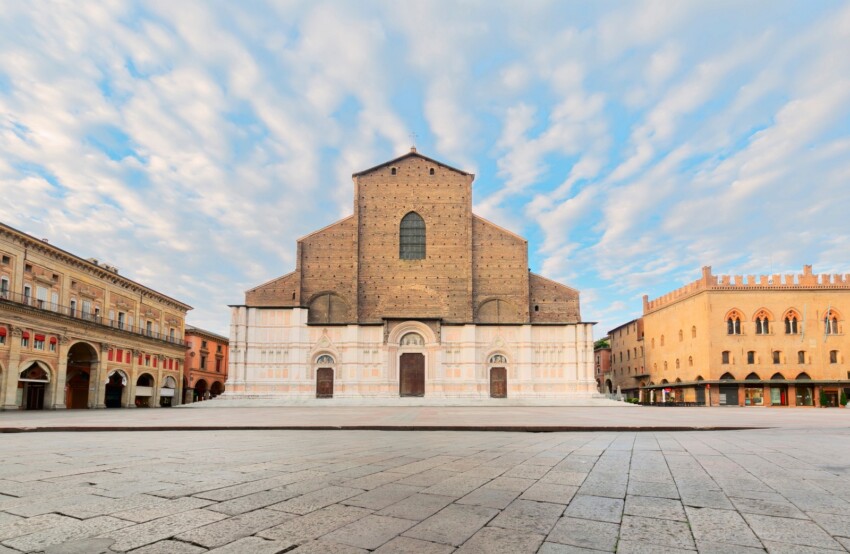
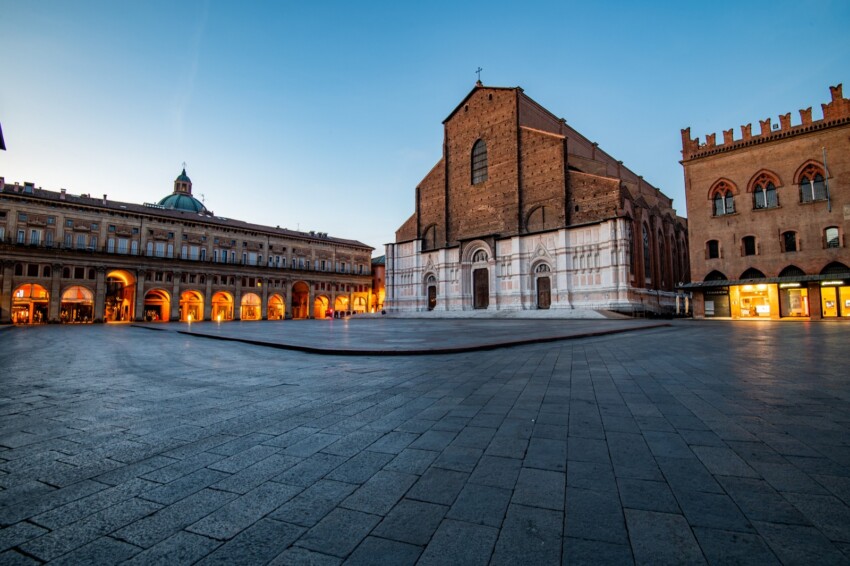
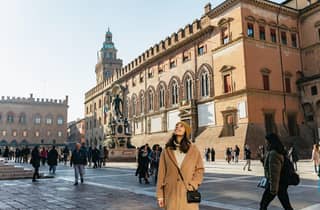
The Basilica of San Petronio, situated in the heart of the city on Piazza Maggiore, is one of Bologna‘s most iconic symbols and one of Italy’s largest and most important churches. Despite construction of the building beginning in the 14th century, visitors are immediately struck by its imposing Gothic façade, which remains unfinished.
This church is dedicated to San Petronio, a 5th-century bishop of Bologna who later became the city’s patron saint, and his remains are preserved within one of the Basilica’s chapels. The Basilica of San Petronio represents not only an important example of architecture but also a site of historical significance and a place of worship for the Catholic community.
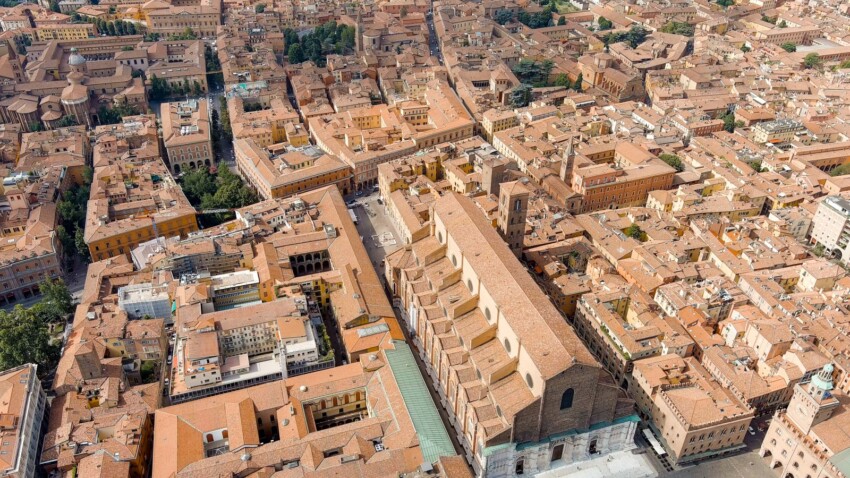
Construction of the Basilica of San Petronio began around 1390 at the behest of Bologna’s Comune, which had proclaimed bishop Petronio the city’s patron saint in place of Saint Peter. The construction project was entrusted to architect Antonio di Vincenzo and from the outset a monumental temple was envisioned that would rival the Basilica of Saint Peter in Rome. The original design called for a church 183 metres long with a Latin cross plan, three aisles and numerous side chapels, but this was altered and scaled down repeatedly over the centuries due to political, historical and economic circumstances.
Nevertheless, the Basilica quickly became a symbol of the city and an important centre for religious and cultural life. Over the centuries some of the greatest artists of the time, including architect Arduino Arriguzzi, Jacopo della Quercia and Baldassarre Peruzzi, were involved in constructing the building. Notably, in 1508 a large bronze statue of Pope Julius II, created by Michelangelo, was placed on the façade, a gesture intended to emphasise papal control over the territory. Another major historical event centring on the Basilica was the 1530 ceremony in which Charles V was crowned Holy Roman Emperor by Pope Clement VII.
Over time construction of the Basilica was halted several times to make way for other buildings, including the Archiginnasio of Bologna, which was intended to house the University’s headquarters. For various reasons, the basilica’s construction ultimately remained incomplete, and today the front elevation is still characterised by a lower section in marble and an upper section in exposed brick.
The exterior of the Basilica of San Petronio is characterised by an imposing façade that dominates Piazza Maggiore and represents a magnificent example of Italian Gothic architecture. As mentioned, the façade is divided into two main sections, with the lower part in white and red marble whilst the upper part is composed of exposed brick, features that give the building a unique and distinctive appearance.
In the lower section is an elegant central portal, designed by Jacopo della Quercia, which is decorated with a series of reliefs depicting biblical scenes and images of saints; flanking this main doorway are two side portals, also decorated with reliefs and statues. The upper part of the façade composed of exposed brick is the section that was never completed over the centuries, despite various projects being presented. On the left side of the building stands an imposing bell tower constructed in the 15th century which, whilst featuring a fairly simple design, stands out as a distinctive element due to its height.
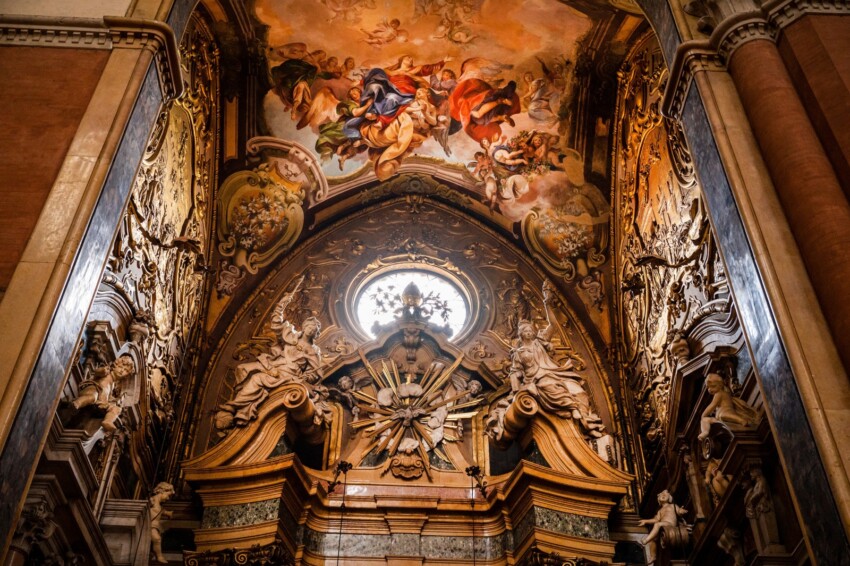
The interior of the Basilica of San Petronio is a vast space divided into three aisles with 22 side chapels, each housing important artworks created over time by various artists. Among the most beautiful side chapels are the Main Chapel, decorated with frescoes by Giovanni da Modena depicting scenes from the Last Judgement, the Chapel of San Vincenzo Ferrer with canvases by Vittorio Bigari, and the Chapel of Sant’Antonio da Padova with works by sculptor Girolamo da Treviso.
Other chapels of great artistic value are the Chapel of the Magi, famous for housing works by Lorenzo Costa created in the 15th century, and the Chapel of San Sebastiano built between 1487 and 1497 at the behest of canon Donato Vaselli. For these latter two, given their high artistic merit, an entrance fee is required. Also worth noting is the Chapel of San Petronio, considered an excellent example of Bolognese Baroque architecture and known particularly for housing the tomb of Bologna’s patron saint. His body is preserved here above the altar in a monumental reliquary in silver with lapis lazuli created by sculptor Francesco Giardoni and donated by Pope Benedict XIV.
Another work of great value both artistically and scientifically and culturally is the meridian, created in 1655 by astronomer Giovanni Domenico Cassini, which marks solar noon and the passage of the seasons. The meridian, situated in the floor of the left aisle, stretches 67 metres and is considered one of the largest in the world. It has also been used to conduct important astronomical studies.
Entry to the Basilica is free and you only pay a ticket to access a paid route that includes visits to the Chapel of the Magi (Bolognini), the Chapel of San Sebastiano and the Chapel of San Vincenzo Ferrer.
The Basilica of San Petronio is open daily from 8:30 to 13:30 and from 15:00 to 18:30, with the last entry 10 minutes before closing time.
Opening hours for the paid route of the Basilica of San Petronio: daily from 9:00 to 13:00 (last entry at 12:45) and from 15:00 to 18:00 (last entry at 17:45).
The best way to reach the Basilica of San Petronio is undoubtedly on foot, as it is located in the city centre right on the central Piazza Maggiore. For those using public transport, the nearest bus stops to the Basilica are those serving lines A, C, 29, 11 and 27 of the TPER service.
The Basilica of San Petronio stands in Bologna's heart at Piazza Maggiore, close to major landmarks including Palazzo Comunale, Sala Borsa and Palazzo del Podestà.

 Hotel
Hotel  Budget accommodations
  Apartments
  Family Hotel
  Luxury Hotel
  Resorts