HOTEL DOZZA
Dozza - Via Emilia 42
Book now
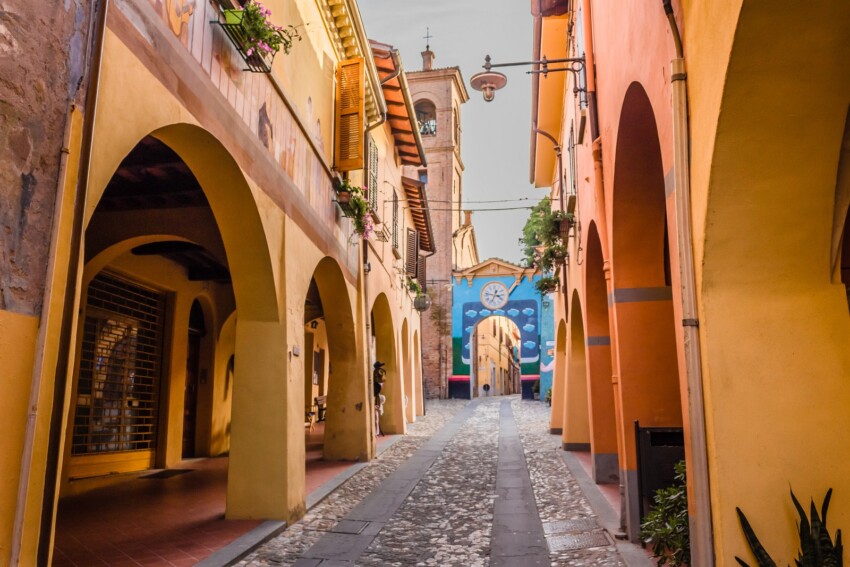
Dozza is a charming medieval village situated just a few kilometres from Bologna, renowned for its cobbled streets, colourful houses and murals that adorn the walls of its buildings. Dozza is the ideal destination for a day trip for those seeking an authentic experience in Emilian history and culture. Indeed, the Sillaro stream flows through its municipal territory, typically marking the western boundary between Romagna and Emilia. The town comprises two localities: Dozza and Toscanella, the latter situated just a few kilometres east of the Sillaro stream, and from Bologna’s perspective, it represents the gateway into the historic-geographical region of Romagna.
This territory was already inhabited during Celtic and Roman times, but it was during the Middle Ages in the twelfth century that a fortified village was founded here on a hilltop overlooking the Sillaro valley. Dozza was indeed considered an important defensive and control point, and as such passed under the rule of various families, most notably the Manfredi and Malatesta, as well as under the control of the Papal State. The Castello di Dozza, constructed in the thirteenth century as a military fortification, represents the heart of the town’s history and underwent various modifications over time, eventually becoming a noble residence. This transformation made the village an important cultural centre, attracting artists and craftsmen who contributed to adorning its streets and buildings.
Today, Dozza remains a captivating village, made unique by the numerous paintings that decorate the facades of its houses, lending them a distinctive and vibrant appearance. It is in this context that the Biennale del Muro Dipinto is organised, the town’s most significant event, which attracts artists of international renown and transforms Dozza into a genuine open-air art gallery. Nowadays, Dozza is known not only for its historical and artistic heritage but also for its wine tradition and the production of high-quality wines, particularly Sangiovese and Pignoletto.
Compact and intimate in scale, Dozza is a small town of considerable charm, part of the “I Borghi più belli d’Italia” (Italy’s Most Beautiful Villages) association, and is well worth exploring on foot along its cobbled streets and colourful buildings.
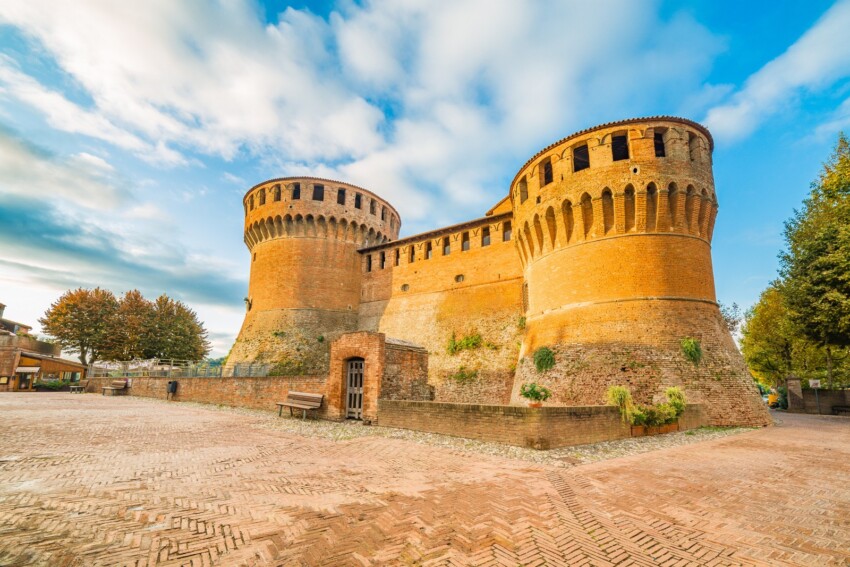
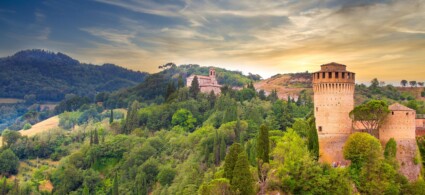
The Castello di Dozza is a fortress that has preserved its medieval structure unchanged and is therefore considered one of the town’s symbols. Originally constructed around the mid-thirteenth century as a military stronghold, the site underwent numerous expansions and modifications during the time of Caterina Sforza, Lady of Imola and Forlì towards the end of the fifteenth century. In the Renaissance period it was further transformed to serve not only as a fortress but also as a noble residence befitting the Campeggi family and later the Bolognese Malvezzi family, who resided here until the twentieth century.
The castle is preserved in excellent condition, with interiors still furnished and decorated with paintings and tapestries dating from the eighteenth century, and kitchens still equipped with utensils from around the sixteenth century. Of note externally are the Rivellino and the Rocchetta, both of fourteenth-century origin, and from the battlement walkway you can admire a breathtaking panoramic view across the surrounding countryside. A visit to the castle is a unique opportunity to trace centuries of Dozza’s history and to appreciate the beauty of its architectural heritage.
The Chiesa di San Lorenzo was built in the nineteenth century over the remains of an earlier medieval church that had fallen into decay. The present religious building features an impressive neoclassical facade and an interior with a single nave, barrel vault and numerous frescoes of considerable quality.
The high altar is dedicated to St Lawrence, whilst the other two altars are dedicated to the Blessed Virgin of Counsel and the Crucifix respectively. Also worthy of mention are paintings of St Anne with the Christ Child, from the school of the Carracci, and a Madonna and Child with St John the Baptist often attributed to the school of Raphael.
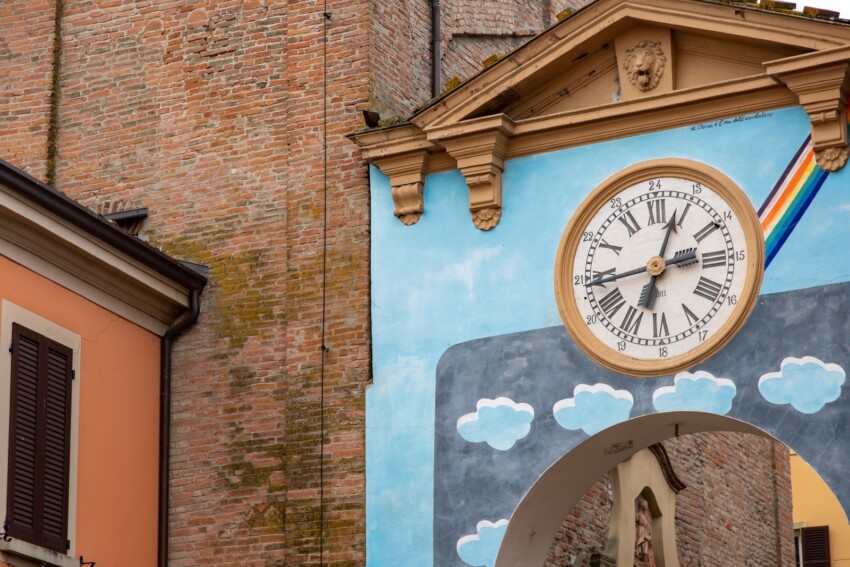
One of Dozza’s most fascinating characteristics is the presence of murals adorning the walls of buildings in the historic centre, transforming the village into an art gallery. These paintings, created by local and international artists, are particularly found on main streets such as Via XX Settembre, Via Edmondo de Amicis and Piazza Giosuè Carducci.
Among the most beautiful and well-known murals is certainly the Angel of Dozza, created by Giuliana Bonazza in 1993, the work “Koncept Dozza” (also known as “postage stamp”) created in 2000 by artist Michael Strejcek, and the Dragon by artist Paolo Barbieri. The best thing to do in Dozza, however, is to wander through the town’s streets without a set plan, searching for these works of art.
The earliest records of a church being built on this site date back to the eleventh century, but what we can admire today is the result of work carried out in 1480 thanks to funding from Caterina Sforza. Further restoration work on the Chiesa dell’Assunzione di Maria Vergine was subsequently undertaken in the early twentieth century. The exterior is currently very simple, featuring exposed brickwork and a single entrance portal surmounted by a relief.
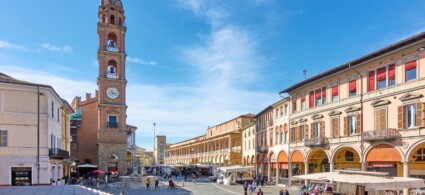
Next to the facade stands a terracotta bell tower dating from the fourteenth century and decorated with a depiction of the Blessed Virgin. The interior presents itself in Renaissance style with a single nave covered by a barrel vault and houses altarpieces of considerable value from the fifteenth century as well as a baptismal font dating from the sixteenth century.
The Enoteca Regionale of Emilia-Romagna is housed within the Castello di Dozza and is an unmissable destination not only for wine lovers but for all those wishing to discover more about the area’s traditions. Here you can taste a selection of local wines, including Sangiovese, Pignoletto and Lambrusco, paired with typical Emilian cuisine. The wine bar also organises wine-themed events, allowing visitors to explore the region’s wine heritage in greater depth.
Dozza is a small and welcoming village, though it does not offer the same number and variety of accommodation as other major towns in the region, such as the nearby Bologna and Imola. Those wishing to stay in Dozza can opt for one of the lodgings in the historic centre so as to experience and savour the village atmosphere. Another option is to stay in nearby towns and visit Dozza on a day trip.
Dozza is well connected by road to nearby towns and is therefore easily accessible by car. From Bologna, for example, you can take the A14 motorway in the direction of Rimini and exit at Dozza for a total journey of around 30 minutes. From Imola, Dozza can be reached in less than half an hour by travelling along the SS9 towards Bologna. From Faenza you can take the SS67 towards Bologna to reach Dozza in approximately 35-40 minutes.
The nearest railway station to Dozza is at Castel San Pietro Terme, approximately 10 km away, served by trains from both Bologna and Imola; from Castel San Pietro, however, you will need to take a bus to reach Dozza. The nearest airports to Dozza are Bologna Guglielmo Marconi Airport, situated approximately 40 km from the town, and Forlì Airport, situated 50 km away.
What's the weather at Dozza? Below are the temperatures and the weather forecast at Dozza for the next few days.
Dozza is a small yet enchanting village in Emilia-Romagna, situated less than 10 km from Imola, 35 km from Bologna and 95 km from Rimini.
 Hotel
Hotel  Budget accommodations
  Apartments
  Family Hotel
  Luxury Hotel
  Resorts